
There are artists whose work changes not only their discipline but the way we look at the world around us. Piet Oudolf is one of them. His gardens are not visited like a park — they are read. One seeks an intention, a structure hidden beneath the apparent disorder. And the more one looks, the more one understands that nothing is left to chance, even what resembles nature left to itself.
The Oudolf paradox: total control of the uncontrollable
What strikes one in Oudolf's work is first and foremost an apparent contradiction. His gardens give the impression of a liberated, almost wild nature — masses of grasses that undulate, perennials that self-seed, dead stems that no one cuts before March. And yet, behind each planting, there is a plan of formidable precision.
These plans — Oudolf draws them by hand, species by species, position by position — have become works of art in their own right. Exhibited in galleries, published in monographs, they resemble musical scores or abstract works of art. Each point, each symbol corresponds to a specific plant, a calculated height, a desired texture. The "freedom" perceived in his gardens is actually the result of a composition as rigorous as a choreography.
Perhaps this is his most radical contribution: demonstrating that nature does not oppose mastery — it is the material of it.
His achievements: gardens that have changed cities
What distinguishes Oudolf from most of his contemporaries is that his gardens have not remained in private properties. They have invested in public space, cultural institutions, and abandoned infrastructures — and in doing so, they have changed the way millions of people perceive greenery in the city.
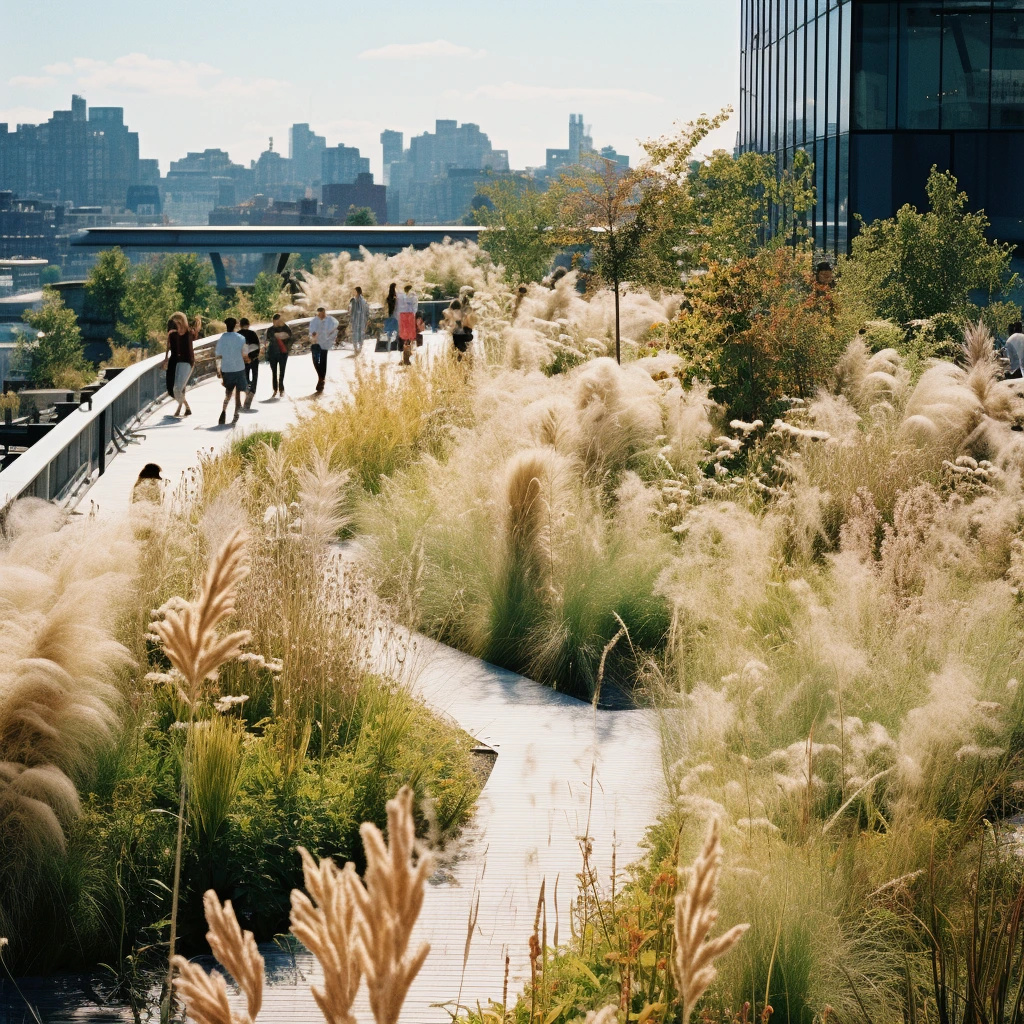
The High Line, New York (2009)This is undoubtedly the project that shifted the public's gaze. An old elevated railway of 2.3 kilometres in Manhattan, converted into a planted walkway above the streets of Chelsea. Oudolf plants over 210 species of perennials, grasses, and shrubs here — a composition that changes radically with the season, the month, and the time of day. The High Line is not a garden you walk through while looking at your feet: it is a space that compels you to look up, to slow down, to watch aSporobolusdancing in the wind above the rooftops of New York. In just a few years, it has become the most photographed public space in the United States. And it has sparked projects in dozens of cities around the world to convert abandoned infrastructures into green spaces — all inspired, closely or loosely, by this model.
The Lurie Garden, Millennium Park, Chicago (2004)Less publicised than the High Line, perhaps more accomplished. A 10,000 m² garden situated on a parking garage roof in the heart of Chicago, designed as a miniaturised and sublimated version of a Great Plains prairie. There is something bold about planting 26,000 perennials in this location — asserting that nature can exist in the heart of one of the densest cities in North America, not as decoration, but as an ecosystem. The Lurie Garden shows millions of visitors each year what a garden designed for all four seasons looks like.
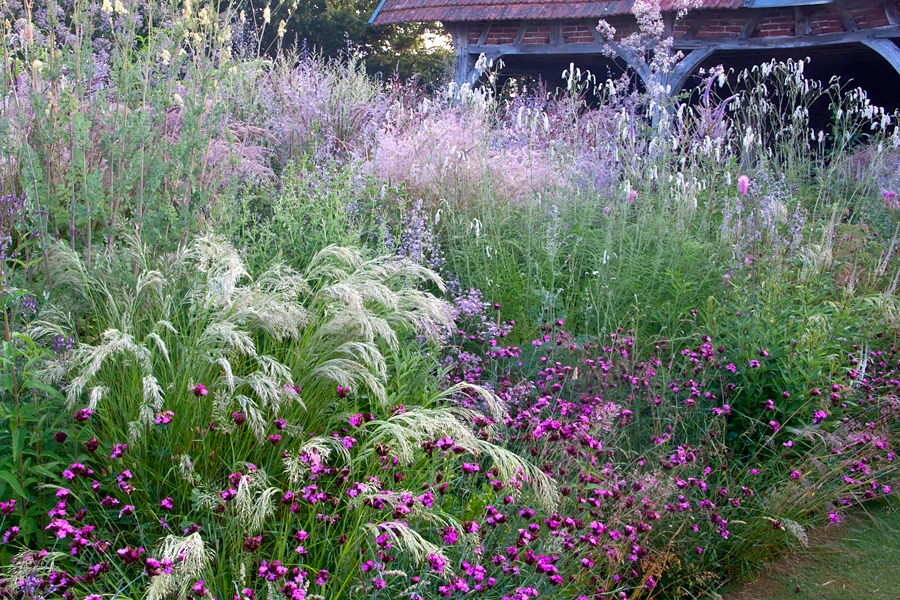
Hauser & Wirth Somerset, England (2014)Here, the commission is different: a contemporary art gallery in a rural setting asks Oudolf to create a garden that interacts with the artworks. The result is a space where the boundary between gardening and visual art completely disappears. It is no longer clear whether the masses ofSanguisorbaandMoliniaare an installation or a planting. It is probably both. This project marks an important moment in the institutional recognition of landscape architecture as a fully-fledged artistic discipline.
RHS Wisley, England (2024)For the historic garden of the Royal Horticultural Society, Oudolf designs a winding path that immerses the visitor in the heart of naturalised plantings — at plant height, no longer above them. A way to redefine the experience of the botanical garden, traditionally organised for scientific observation, into something more sensory and intimate.
Calder Gardens, Philadelphia (2025)His collaboration with architects Herzog & de Meuron for this museum dedicated to Alexander Calder may be his most conceptually ambitious project. Calder's sculptures — mobiles, balancing acts, in perpetual motion — find an unexpected resonance in Oudolf's plantings: he too works on movement, on the fragile balance between structure and freedom, between the intended work and what time makes of it. It is a conversation between two artists across the decades.
What these projects have in commonBeyond their geographical and programmatic diversity, these achievements share a rare quality: they transform their context. The High Line has regenerated a neighbourhood. The Lurie Garden has demonstrated that a parking roof can become a sanctuary. Hauser & Wirth Somerset has brought the garden into the world of contemporary art. Oudolf does not design gardens that adapt to their environment — he designs gardens that change their environment.
The beauty of decline — a philosophical question
We can pinpoint the moment when the garden changed its nature in Western thought: it was when Oudolf asked a simple, yet disturbing question.Why cut back dead stems in autumn?
The obvious answer — because it looks ugly — never seemed satisfactory to him. So he began photographing his plantings in December, in January, under the frost. And what he showed the world changed the perspective of an entire generation of landscape architects: anEchinacea purpureawhose dried head stands out against a foggy sky is just as beautiful, in its own way, as when in full summer bloom. Beautiful in a different way. A beauty that requires more attention, more inner disposition.
This idea — that decline has its own aesthetic, that the apparent death of a garden is a phase of its life and not its absence — is deeply philosophical. It touches on our relationship with time, with impermanence, with what we choose to see or prefer to mask. Oudolf does not just plant perennials: he invites us to reconsider what we call beauty.
Thinking in communities, not in specimens
Another essential break in his work concerns the unity of composition. The traditional garden thinks inspecimens: one places a rose bush here, a trimmed boxwood there, a peony for the June bloom. Oudolf, on the other hand, thinks inplant communities— as an ecologist would observe a natural meadow.
In a meadow, species mix, support each other, occupy different niches in space and time. A tall grass creates shade at its base where a low perennial can settle. A plant that blooms in May makes way for another that takes over in August. Together, they form a coherent system, not a collection of individuals.
This systemic thinking has concrete implications for maintenance. A garden designed as a plant community partially regulates itself. Plants cover the ground, limiting weeds. Species adapted to the local climate cope better with dry summers. One maintains less, but observes more.
What his books reveal that his gardens do not show
Oudolf is also a theorist. His works —Planting: A New Perspective(with Noel Kingsbury),Hummelo, Landscapes in Landscapes— are not catalogues of plants. They are manifestos on how to look, compose, and let be.
InHummelo, he documents his own garden in the Netherlands over several decades. What stands out is the temporal dimension of the work: an Oudolf garden is never "finished". It is different in year 3 than in year 1, different in year 10. Some species disappear, others take over. The landscape designer intervenes, adjusts, sometimes accepting results he had not anticipated.
It is a rare stance in a creative world where the work is generally expected to remain true to the initial intention. Oudolf, however, incorporates surprise as a compositional element. His work endures over time because it evolves with it.
The influence on our way of gardening in Belgium
What makes Oudolf's thinking particularly relevant for Belgian gardens is his climate pragmatism. His species —Molinia caerulea, Persicaria amplexicaulis, Sesleria, Sporobolus— are either native to our latitudes or perfectly adapted to our wet winters and increasingly dry summers.
But beyond the species, it is the approach that changes everything. Designing a Belgian garden through Oudolf's eyes means accepting not to control everything. It is about planting densely from the start so that the plants find their own balance. It is resisting the urge to cut back in November what will be remarkable in February under the first frosts.
It is, ultimately, about trusting the living.
Questions to go further
Are Oudolf's plans accessible to the general public?Some are exhibited in museums or published in his books. They resemble abstract graphic works — and it is precisely their dual nature that makes them fascinating: technical documents that are also works of art.
How can one integrate his philosophy without having a large garden?The essence of his approach — structural plants, winter beauty, mass composition rather than specimen — applies from 30-40 m². It is not a question of area, it is a question of perspective.
Are there any Belgian landscapers working in this vein?Yes. The naturalist movement is gaining ground in Belgium, particularly in Walloon Brabant where large residential gardens provide the necessary space for this type of composition. This is a direction we are exploring at Vert Val SRL for projects where the client desires a living, evolving garden, less dependent on weekly mowing.