
When we analyse existing terraces, we often find the same scenario: a large mineral surface has been created, solid, durable... but without thorough consideration of the furniture.
Only then do the table, chairs, and lounge come in. We adapt as best we can. We move things around. We overload. And the space appears either empty or cluttered.
Designinggardens with integrated furniture, is to reverse this logic. We think about the use first. The form comes afterwards.
Standard or custom furniture: two complementary approaches
Of course, there is today a very high-quality offer of ready-to-use outdoor furniture. But we must not forget a often more coherent alternative: custom furniture.
In our projects, whether in Brussels in narrow gardens, or in villas in Walloon Brabant and Flemish Brabant — we regularly create:
custom planters,
benches integrated into walls,
wood or stone benches integrated at ground levels,
planters with integrated seating,
storage boxes integrated into the structure.
Customisation allows for precise adjustment of dimensions, integration of storage for cushions, and structuring of space. A well-placed planter can both partition, protect from the wind, and create a natural backrest for a bench.
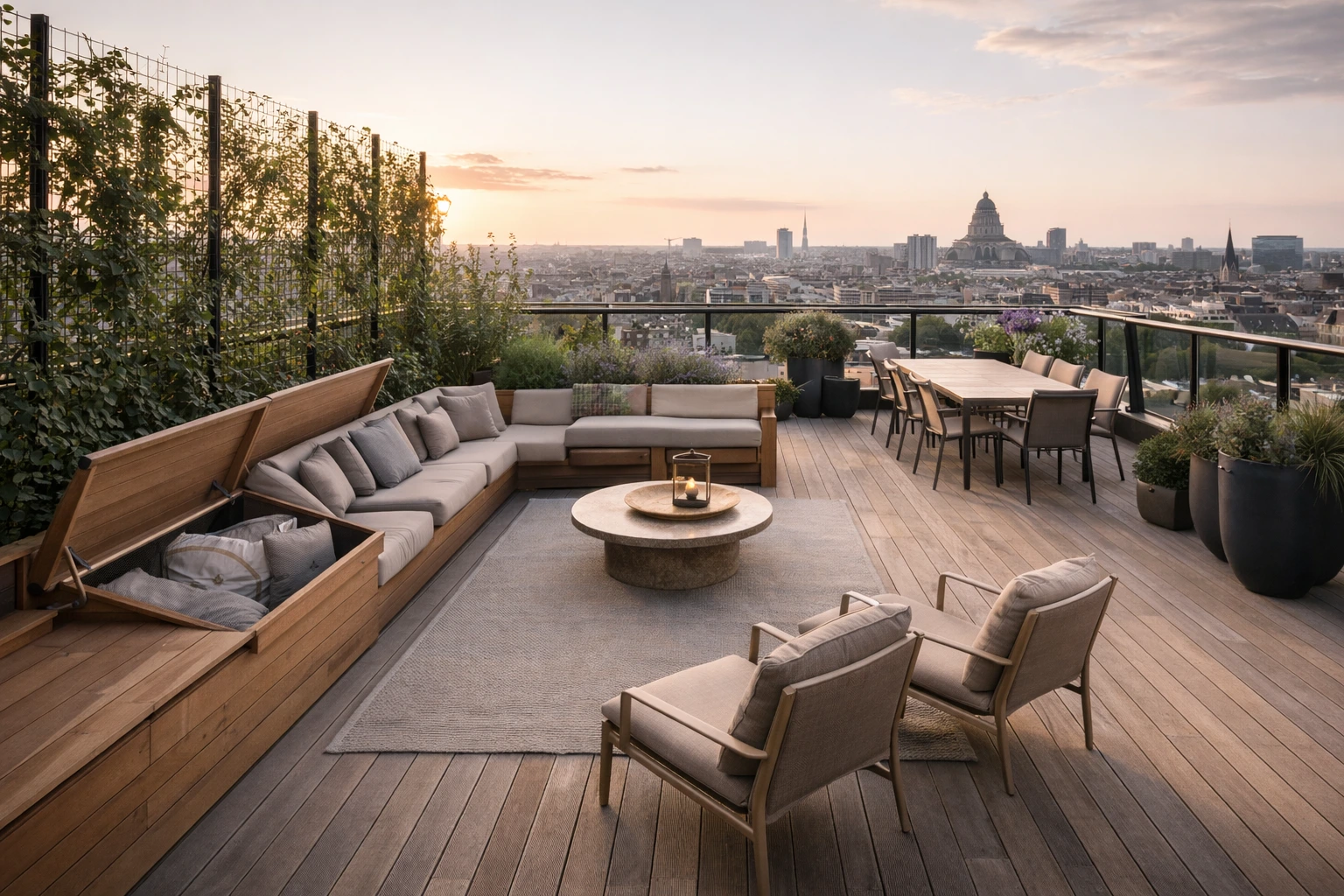
Reduce the effect of a 'mineral plateau' without demolishing everything.
Many of the terraces are too large and too mineral. This does not mean that everything needs to be demolished.
Here are some simple and effective interventions:
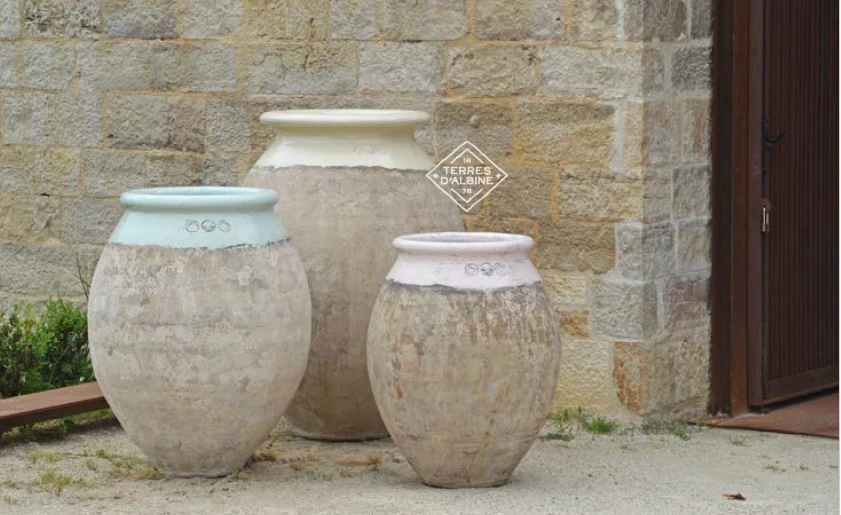
1. Install large pots
Well-sized pots allow for:
structuring the space,
creating distinct areas,
softening the visual impact of the paving.
Two or three large containers can completely transform the perception of a terrace.
2. Add planters to partition
Long planters can:
separate a dining area from a lounge area,
protect from the wind,
frame a passage.
This allows for a more coherent arrangement of furniture without actually reducing the usable space.
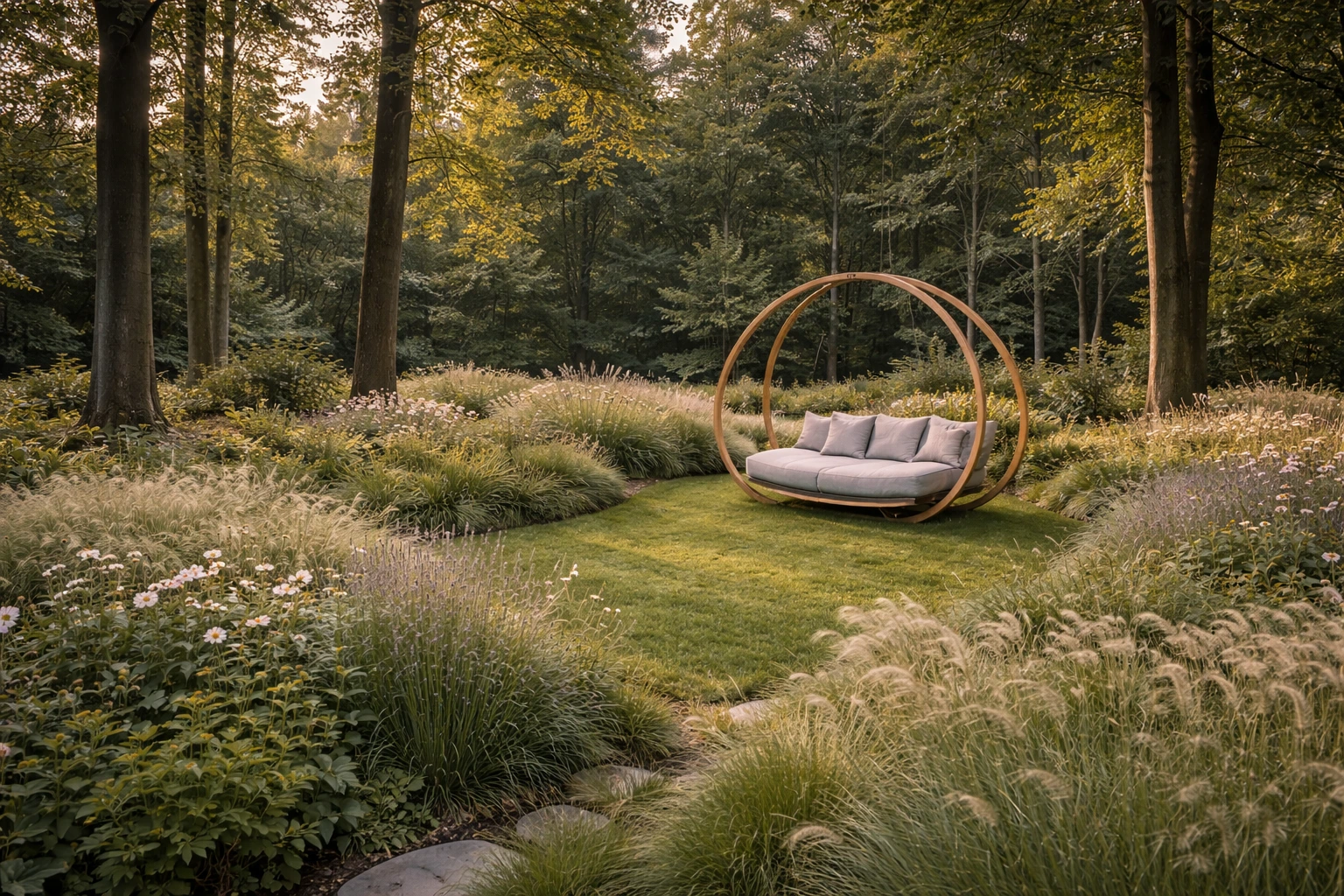
3. Create a second space in the garden
If space allows, we often recommend moving some of the furniture off the terrace:
a small wooden platform in the grass,
a bench in a planted area,
a reading nook under a tree.
The garden becomes a collection of micro-spaces rather than a single central point.
Test before buying: simple and effective methods
We often give our clients these very pragmatic pieces of advice:
✔ Use cardboard templates
Cut out cardboard to the exact dimensions of the intended furniture. Place them on the terrace. This allows you to visualise:
the actual space taken up,
the circulation paths,
the conflicts of use.
It’s a simple, quick, and very revealing test.
✔ Measure the circulation flows
A comfortable passage generally requires:
a minimum of 80 cm for a single passage,
ideally 90 to 100 cm in main areas.
Around a table, you need to allow for the space taken by chairs (approximately 60 cm minimum behind each chair).
Many terraces seem large, but quickly become narrow as soon as the chairs are pulled out.
Choose adaptable furniture
A fundamental point we always address: flexibility.
A large fixed table can visually dominate the terrace when it is only used by two people.
We often recommend:
an extendable table,
a modular table,
or a more compact table complemented by extensions.
Yes, this can sometimes represent a higher investment. But the aesthetic and functional gain is considerable: the space remains breathable most of the time.
Incorporate storage from the design stage
A garden with integrated furniture is not limited to seating.
You need to think about:
for the storage of cushions,
for protective covers,
for quick access in case of a shower.
In Walloon Brabant or the south of Brussels, rainy episodes are frequent. If storage is far away or impractical, the furniture will be used less.
A custom bench can incorporate a discreet storage box. A technical room can be designed to accommodate textiles. Daily use must be simple.
Adapting furniture to the local context
We operate in:
compact urban gardens in Brussels,
in façade houses with narrow gardens,
as well as in more open villas in Flemish Brabant or Walloon Brabant.
In narrow gardens, vertical integration (screens, tall planters, integrated benches) is essential to structure without weighing down.
In larger gardens, the challenge is different: to prevent the furniture from getting lost in the space. We then create 'outdoor rooms' using structural planting.
Thinking about Belgian seasons
Integrated furniture must withstand:
humidity,
frost,
marked seasonal cycles.
Materials must be selected accordingly: treated or sustainable wood, protected metal, stone suitable for the climate.
And above all, shade must be anticipated. A perfect space in April can become unusable in July if no sun protection is provided.
What we observe with our clients
When furniture is integrated from the design stage:
the terrace can be more compact,
the garden seems larger,
the spaces are better organised,
the use becomes intuitive.
We no longer just 'place' furniture. We truly inhabit the space.
Conclusion
Designinggardens with integrated furniture, means thinking of the outdoors as a succession of uses, adapted to the Belgian climate and current lifestyles.
Whether it is an urban garden in Brussels or a villa in Walloon or Flemish Brabant, the goal remains the same: to create coherent, comfortable, and sustainable spaces.
Furniture is not an accessory. It is a tool of landscape architecture.