
There is a question rarely asked in front of the gardens of Versailles, so much does their beauty paralyse any critical thought:who do they really serve?Not the plants, certainly. Not the birds. Not even the walker, whose path is meticulously orchestrated from the façade of the château to the end of the Grand Canal. These gardens serve an idea — the one that a man, the Sun King, wanted to impose on the world: that nature obeys. That it can be tamed, shaped, made symmetrical, pressed to the ground like a signature. André Le Nôtre is the artist who made this possible. And this ambition, however grand it may be, changed everything in the history of the Western garden.
A gardener trained as an architect
Le Nôtre was born in 1613 into a family of royal gardeners — his father and grandfather were already attached to the gardens of the Tuileries. The legacy could have confined him to a transmission of trade. He made something else of it. Where most of his contemporaries learned to plant, he learned to see. He studied architecture with François Mansart, painting with Simon Vouet, and mathematics as a self-taught individual. This is not an anecdotal curiosity — it is the key to his entire work.
Because Le Nôtre never approaches a garden as a botanist or a horticulturist. He approaches it as an optical, architectural, mathematical problem. The plant is a material, just like stone or water. What interests him is what the eye perceives — and above all, how to make it perceived differently.
Vaux-le-Vicomte: the garden that cost the freedom of its patron
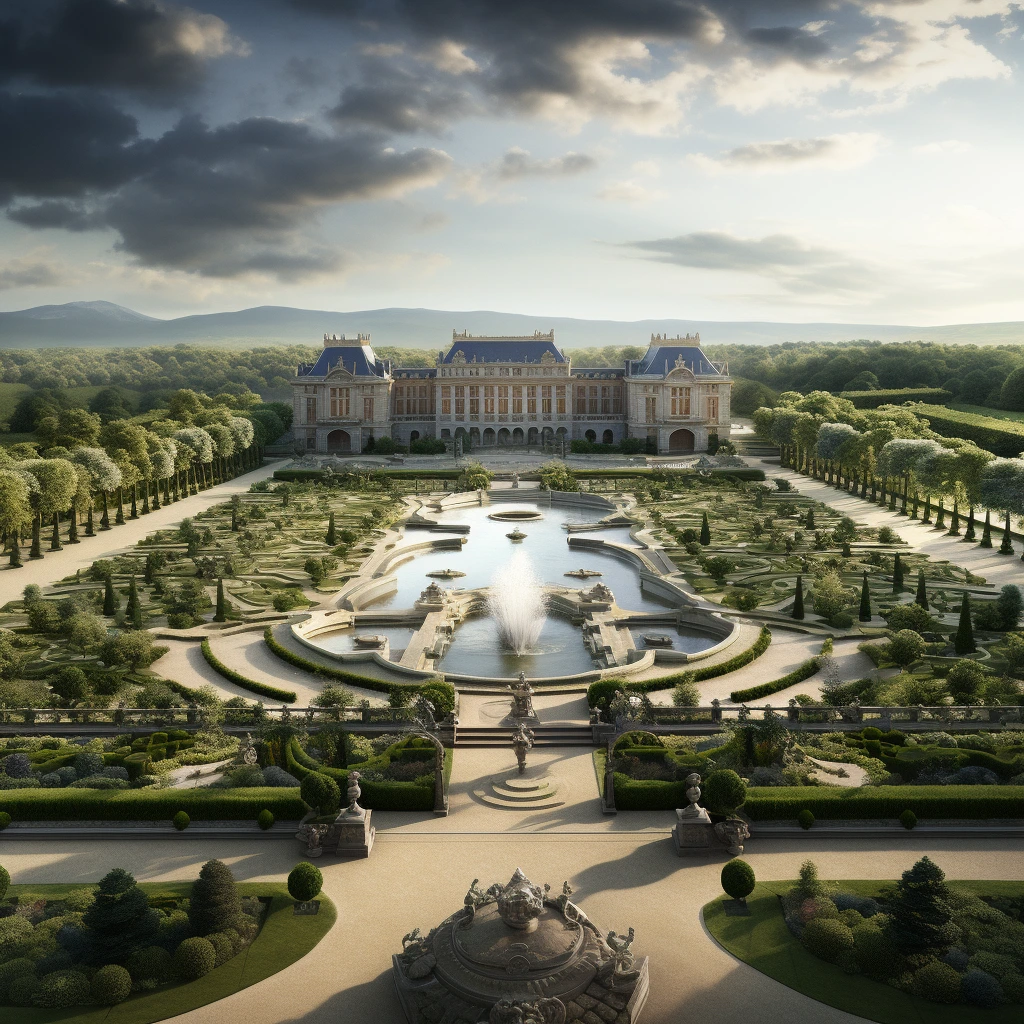
In 1656, Nicolas Fouquet, Superintendent of Finance to Louis XIV, commissioned three men to create an estate that would be the absolute demonstration of his power: the architect Louis Le Vau, the painter Charles Le Brun, and the gardener André Le Nôtre. The result — Vaux-le-Vicomte — is universally recognised as the founding work of the French garden.
But the story of Vaux-le-Vicomte is also a lesson in politics. On the evening of 17 August 1661, Fouquet organised a sumptuous party for the king. Three weeks later, he was arrested on the orders of Louis XIV and would never emerge from prison. The beauty of Vaux-le-Vicomte had revealed something unacceptable in the eyes of the monarch: that a subject could command something greater than him.
Louis XIV then summoned Le Nôtre to his service. And Versailles began.
There is something dizzying in this sequence: the same man, with the same tools, designs the garden that liberates and the garden that imprisons. Le Nôtre does not choose his patrons — he serves the power that commands him. His genius is amoral, in the strictest sense of the term. This is one of the most fascinating tensions in his work.
The mastery of perspective — a magnificent lie
Technically, what distinguishes Le Nôtre from all his predecessors is his mastery of forced perspective. At Vaux-le-Vicomte as at Versailles, he manipulates distances and proportions to create optical illusions of astonishing precision.
Standing on the terrace of Versailles, facing the Grand Canal, it seems within reach. It measures 1.5 kilometres. Le Nôtre achieves this effect by gradually reducing the width of the paths and the size of the boxwood as one moves away from the château — a technique borrowed from perspective painting and applied on the scale of an entire landscape.
This is not deception in the ordinary sense. It is a demonstration of mastery. The visitor is invited into a space where their own senses deceive them — and where this deception is executed so well that it becomes a complete aesthetic experience. One could say that Le Nôtre invented, three centuries ahead of his time, the concept of immersion.
Versailles: nature subjected to the reason of state
Versailles is the radical culmination of this thought. There, no ambiguity remains: nature is not tamed, it is denied. Every tree is shaped according to a form decided by man. Every body of water reflects exactly what has been intended for it to reflect. The parterres de broderie — these plant motifs as precise as lace — require constant maintenance to maintain their shape against the natural impulse of plants to grow freely.
Louis XIV himself wrote a guide to visiting the gardens —The way to show the gardens of Versailles— which prescribes to the visitor in what order to look, where to stop, which perspective to contemplate first. The garden is not a free space: it is a theatre whose director controls even the movement of the spectator.
It's dizzying when you think about it. And it's the exact opposite of Piet Oudolf, who accepts and celebrates what he cannot control. These two men, separated by three centuries, represent the two poles between which all thought about the garden still oscillates today: absolute mastery or willing abandonment.
What Le Nôtre still teaches us
No one designs like Le Nôtre for a residential garden in 2025 — or at least, not on that scale. But his influence is everywhere, often in forms that we no longer recognise as such.
The axis of perspective that structures a garden path, the symmetry of an ornamental kitchen garden, the raised terrace that imposes a viewpoint on the rest of the property — all gestures that descend directly from his compositional grammar. Le Nôtre invented a language. Some of his words have become so common that we no longer know they belong to him.
He also teaches us that the garden is always a statement. Not necessarily political in the 17th-century sense, but philosophical: what we choose to do with outdoor space says something about what we think of nature, time, order, beauty. A garden trimmed to the millimetre and a garden left to its own dynamics do not speak of the same relationship to the world.
Questions to go further
Can we visit Vaux-le-Vicomte today?Yes — and it may be the best way to understand Le Nôtre, because Vaux-le-Vicomte is human-scaled where Versailles overwhelms. One can better perceive the precision of the composition, the subtlety of the effects of perspective, the intelligence of a garden that reveals itself differently depending on where you stand.
Is the Le Nôtre style applicable to a contemporary garden?Some principles — the structuring axis, symmetry, vanishing points — integrate very well into a contemporary residential garden, especially for large properties. The challenge is to adapt them without falling into pastiche: to draw inspiration from the grammar without imitating the era.
What is the connection between Le Nôtre and current Belgian landscaping?Belgium has a long tradition of formal gardens — castles, abbeys, estates in Walloon Brabant — which are directly part of the Le Nôtre heritage.