
A client called me a few weeks ago from Uccle. His city garden was about forty square metres, wedged between two high walls and an existing terrace attached to the house. He said to me: I don’t know what to do with it, it looks like nothing. Upon arriving on site, I immediately saw the potential — not despite the constraints, but thanks to them. A city garden is designed. It is structured. And when done well, it becomes one of the most beautiful rooms in the house.
Here are the main principles that I apply in the design of urban gardens in Brussels and in Walloon Brabant — from Watermael-Boitsfort to Rixensart, passing through Uccle and Auderghem.
Structure first: the hard before the green
The first mistake in a small city garden is to start with the plants. You plant, you fill in, and you end up with a space that lacks clarity — too cluttered or too soft, without a clear framework. My approach is the opposite: I always start with the mineral structure and built volumes before integrating the vegetation.
This means clearly defining the living spaces — terrace, paths, planting areas — and ensuring they are sized for actual use. A terrace that is too small will never be used. A path that is too narrow will be avoided. The comfort of use takes precedence over aesthetics, and the two are not incompatible.
A key principle: always plan for greenery at the base of every hard surface. A terrace bordered by a planted strip, a path alongside a flowerbed, a wall dressed at its base with perennials or grasses — this contact between the mineral and the vegetal is what brings the whole to life.
Play with textures: the visual impact through the contrast of materials.
In an urban garden, non-vegetal surfaces occupy an important place. This is precisely where a large part of the visual impact occurs. The mistake would be to treat everything in the same material. What creates interest is the dialogue between the materials.
The combinations that work well in our Belgian gardens:
• Belgian blue stone or brushed concrete (smooth, structured) + fine or stabilised gravel (rough, permeable): a classic that never goes out of style.
• Corten steel: its warm rust tones contrast beautifully with the green of the plants and the grey of the walls. To be used for flowerbed edges, low walls or screens.
• Wood (cladding, terrace, pergola): it brings warmth and naturalness. In contrast with a wall painted white or anthracite grey, the effect is immediate.
• Lime or render on the walls: a lime finish gives a lively, slightly irregular texture that absorbs light differently depending on the time of day. Much more interesting than a simple matte paint.
• Metal (black, anthracite) for privacy screens, trellises or lightweight structures: understated, modern, durable — and it allows light to filter through while preserving intimacy.
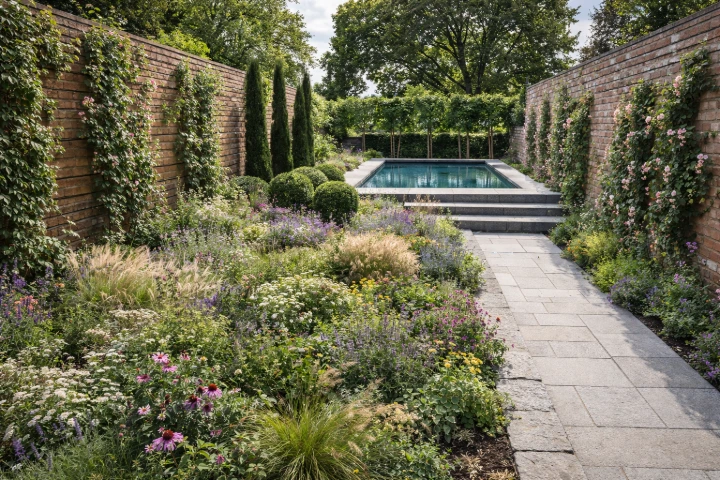
The unity of colours: the less you use, the more beautiful it is.
In a small space, the multiplication of colours and materials creates visual agitation — and the impression that the garden is even smaller. My simplest and most effective advice: choose a palette of two or three tones and stick to it from the ground to the wall.
If your house has anthracite grey joinery, incorporate this grey into the terrace materials, the screens, the pots. If you opt for natural wood for wall cladding, carry this warm tone into the outdoor furniture. This coherence creates a sense of space and calm that is exactly what one seeks in an urban garden.
For party walls or fences: do not leave them in their raw state if it detracts from the whole. A paint in a warm tone, wooden cladding, or even a lime render can radically transform the atmosphere of the garden for a reasonable budget.
Terraces: do not always place them parallel to the wall.
This is a detail that changes everything. In most city gardens I visit, the terrace is laid out in a perfect rectangle, parallel to the facade — which accentuates the elongated shape of the garden and makes it appear even narrower visually.
Slightly offsetting the terrace — at an angle, with a 30 or 45 degree angle to the wall — immediately creates a dynamic. The gaze no longer goes directly to the back; it is guided, diverted, invited to explore. This simple rotation is sometimes enough to transform the perception of space.
I often create several distinct areas in the same garden: a main terrace close to the house, a second, more intimate resting space at the back — separated by a path, a planted bed, or a simple change of surface. These different atmospheres in the same space give the impression of a garden much larger than it actually is.
Lighting: the city garden also exists at night
It is often the poor relation of city garden projects — and yet, it is what makes the difference between a garden that one enjoys looking at from the window in the evening, and a garden that disappears into the darkness as soon as night falls.
My basic principle: never light directly downwards from above. Prefer lighting from below — buried or ground-mounted spots that illuminate the trees or structural shrubs. The result, seen from inside the house, is spectacular: the plant volumes stand out in the night, shadows play on the walls, and the garden seems to deepen.
Best practices:
• Light multi-stemmed trees from below to create plays of shadow and light on the surrounding walls.
• Place grazing lights at the base of rendered or clad walls to reveal textures.
• Use garlands or lanterns for living areas — a warmer, softer light that invites lingering.
• Avoid cold white tones (>4000K): warm light (2700-3000K) is much more pleasant in residential outdoor spaces.
Screens, mirrors, and false doors: the art of enlarging space
In very constrained city gardens, I willingly use visual tricks that play on depth and the perception of space.
Firstly, privacy screens. Rather than leaving a bare wall or a basic fence, one can install metal screens or wooden trellises dressed with climbing plants (clematis, roses, honeysuckle). These elements provide both intimacy, texture, and a verticality that structures the space.
Outdoor mirrors are a formidable tool in a small garden. Placed at the back or on a side wall, a garden mirror visually doubles the space, reflects the vegetation, and creates the illusion of continuity beyond the wall. It simply needs to be oriented correctly to maintain the illusion.
The false door or the painted trompe-l'œil archway on a back wall is an ancient technique that remains effective. Combined with a planter in front and discreet lighting, it gives the impression that the garden extends beyond the wall — particularly useful in the gardens of Uccle or Waterloo where the backs meet an imposing party wall.
Decorative objects — stone benches, statues, basins — play a structuring role when well placed. They create focal points that guide the eye and provide depth. The key: do not overload. One or two strong elements are better than a disparate collection.
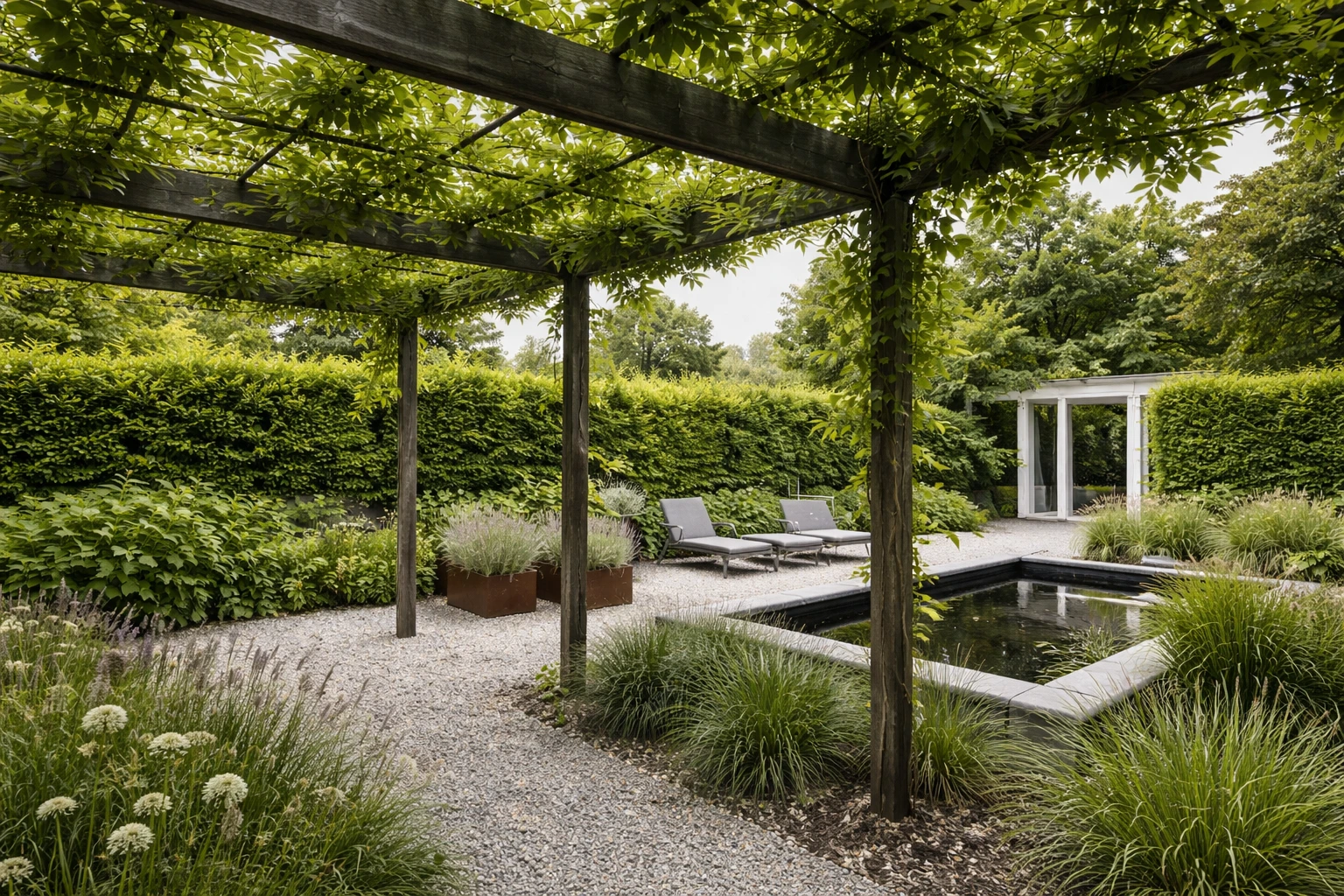
Think about maintenance from the design stage.
A well-designed city garden should also be easy to maintain. In our gardens in Brabant Wallon and the south of Brussels, owners rarely have the time to spend two hours every weekend gardening. This is a consideration I integrate from the start.
• Choose persistent structural plants that maintain their shape without frequent pruning (osmanthus, pittosporum, Ilex crenata).
• Completely cover the ground with dense groundcovers that leave no room for weeds.
• Consider the adult height of plants from the planting stage — anticipate so you don't have to prune everything back in two years.
• Prefer hard surfaces to lawns in shaded or high-traffic areas: zero maintenance, clean results all year round.
A city garden is designed before it is planted.
Behind every beautiful urban garden that I create — in La Hulpe, Genval, Woluwe-Saint-Pierre or in the alleys of Ixelles — there is a reflection on structure, materials, light, and use even before a plant is chosen. This is the work of a landscape architect: not just knowing what to plant, but knowing how to construct the space so that everything works together.
If your city garden seems to lack potential or impact, an on-site consultation visit is often the best starting point. In an hour, we identify what is not working and outline the main directions.
---
FAQ — Urban garden design
What should I start with to landscape a small city garden?
Always start with the structure: define the areas of use and choose your main materials before thinking about plants. A well-structured garden with few plants will always be more successful than a garden overloaded with plants without a framework.
How can I visually enlarge a city garden that is too small?
Several levers: unified colour palette, angled raised terrace, garden mirror at the back, several distinct atmospheres with screens, and under-lighting to create depth.
What materials to choose for an urban garden terrace in Brussels?
Belgian blue stone remains a safe bet. Large format brushed concrete offers a contemporary finish. Wood brings warmth and a natural feel. In any case, mix two materials — a main surface and a contrasting detail — rather than using a single covering across the entire terrace.