
Zaha Hadid: the architect who envisioned landscape
Let’s be precise from the outset: Zaha Hadid was not a landscape architect. She was an architect — one of the most important of her time, the first woman to receive the Pritzker Prize. And yet, few creators have as much to say to those who design landscapes. Here is who she was, and why her work speaks to us.
An architect, not a landscape architect — and one of the greatest
Zaha Hadid was born in 1950 in Baghdad and died in 2016 in Miami. Her journey is that of a pioneer: she first studied mathematics at the American University of Beirut, before moving to London and the prestigious Architectural Association, a hub of the most radical architectural thinking of the 1970s. There she met Rem Koolhaas, with whom she would collaborate, and then founded her own firm, Zaha Hadid Architects, in the late 1970s.
Recognition would follow, immense. In 2004, she became thefirst woman to receive the Pritzker Prize— the equivalent of the Nobel Prize for architecture. She would win the Stirling Prize twice, be made a Dame by Queen Elizabeth II, and become, shortly before her death, the first woman to receive the Royal Gold Medal from the RIBA in her own right. She was nicknamed "the queen of the curve".
A body of work that changed the skyline of cities
Hadid gained worldwide recognition in 1983 with a competition project for The Peak in Hong Kong — a building that remained on paper, but heralded everything. Her first built structure would be the fire station at the Vitra campus in Germany, in 1993.
Next will be buildings that have marked contemporary architecture: the MAXXI, contemporary art museum in Rome; the Heydar Aliyev Centre in Baku; the Rosenthal Centre for Contemporary Art in Cincinnati; the London Aquatics Centre for the 2012 Games. And — for us, here — thePort House in Antwerp(2016), a creation by Zaha Hadid on Belgian soil: an extraordinary glass structure set on an old fire station, a must-see.
Why her work speaks to landscape architects
Here is what makes Zaha Hadid exciting for those who design gardens, even though she was never a landscape architect:few architects have thought as much about the ground.
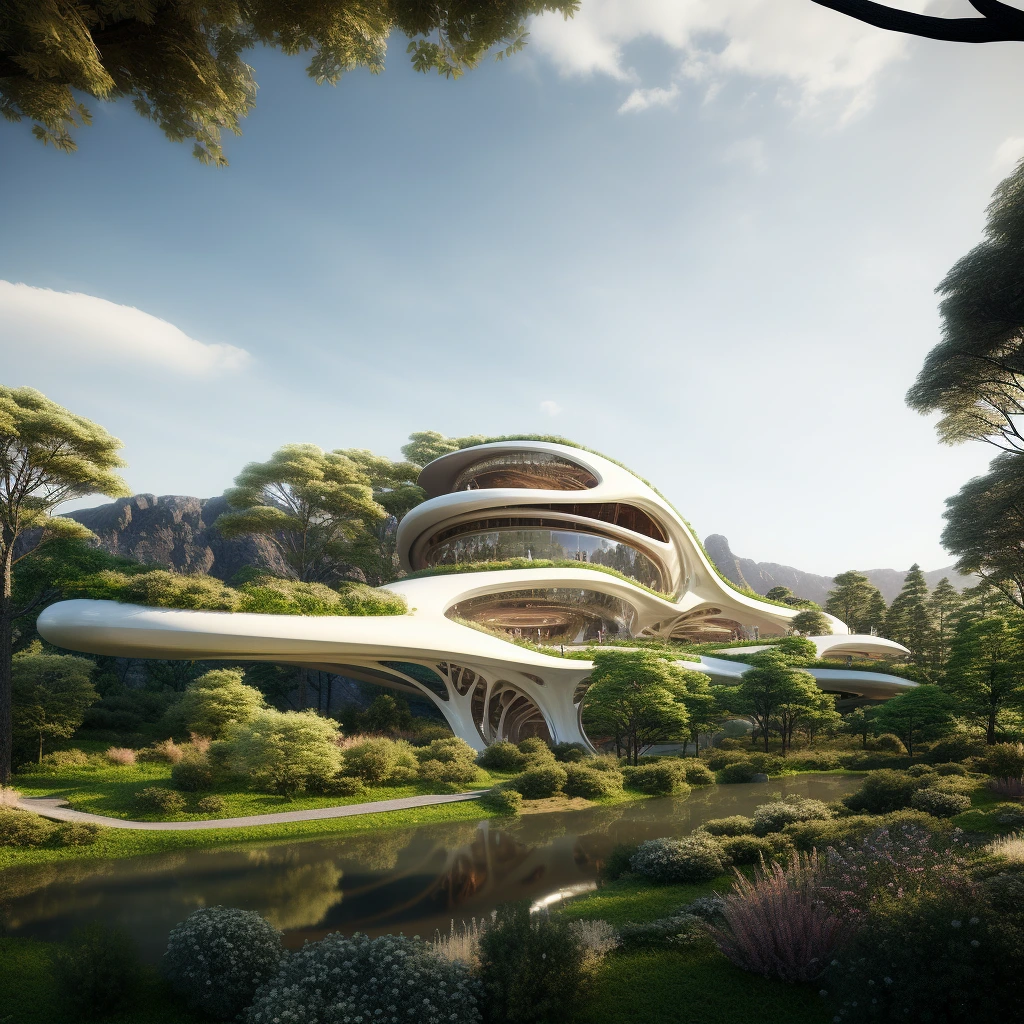
Hadid began each project with a thorough study of the site and its topography. And her buildings do not sit on the ground like an object placed there: they seem to emerge from it, born from the folds of the terrain. She spent her career challenging the "static idea of the ground" — this ground that modern architecture treated as a mere neutral base. For her, the ground becomes fluid, continuous; the straight line disappears; the boundary between the built and the ground dissolves.
And this is exactly a landscape architect's way of thinking. A garden is also about the ground — about shaping, continuous surfaces, and how one moves through space. Hadid pushed this idea to a radical extreme, in the language of architecture. There is even a literal bridge: in 1999, she designed a building for a German horticultural exhibition, the Landesgartenschau — proof that her work has, at times, directly encountered the garden.
What we take from it
We do not build like Zaha Hadid — a residential garden is not a parametric sculpture, and that is perfectly fine.
But her central lesson applies at all scales:the ground is not a neutral base, it is the primary material.Shaping the land, thinking of circulation as fluid and continuous lines, ensuring that a project emerges from its site rather than imposing itself upon it: this is precisely how we approach a garden at Vert Val. Zaha Hadid does not give us a style to imitate. She reminds us, with rare strength, where everything begins — the ground.
Frequently Asked Questions
Who was Zaha Hadid?
Zaha Hadid (1950-2016) was an Iraqi-British architect, one of the most influential of her generation. Educated at the Architectural Association in London, she founded the firm Zaha Hadid Architects and was, in 2004, the first woman to receive the Pritzker Prize.
Was Zaha Hadid a landscape architect?
No. Zaha Hadid was an architect — not a landscape architect. The confusion is common but inaccurate. Her work remains very inspiring for landscape architects, due to her way of thinking about the ground, topography, and continuous surfaces.
What are Zaha Hadid's most famous works?
Among her major achievements: the Vitra Fire Station in Germany, the MAXXI Museum in Rome, the Heydar Aliyev Centre in Baku, the London Aquatics Centre, and the Port House in Antwerp, Belgium.
Did Zaha Hadid complete a project in Belgium?
Yes. The Port House (Havenhuis) in Antwerp, completed in 2016, is a project by Zaha Hadid Architects: a spectacular glass volume set above a renovated former fire station.
In summary
Zaha Hadid does not belong to the history of the garden — she belongs to that of architecture, right at the top. But her obsession with the ground, the relief, and the fluid line makes her an unexpected and valuable reference for landscape architects. She reminds us that to design a space is first to design the ground we walk on.