
Frederick Law Olmsted, the father of landscape architecture
The profession of landscape architect has a founder — and surprisingly, he had never studied gardening. Frederick Law Olmsted was a farmer, journalist, and writer before becoming, later in life, the man who invented a profession and gave the world a new idea: that nature in the city is not a decoration, but a necessity. Here is his journey, and what his vision can still teach us.
A farmer-journalist turned inventor of a profession
Frederick Law Olmsted was born in 1822 in Hartford, Connecticut. His youth was nothing like a landscape architect's training: he ran a farm on Staten Island, travelled, and made a name for himself primarily as a journalist and writer. His travel accounts through the Southern United States, where he documented the reality of slavery, made him a respected figure in the press of his time.
One journey will change everything. In 1850, Olmsted discovered Birkenhead Park in England, near Liverpool — one of the first public parks funded by the community, open to all. The revelation was profound: a space of nature, in the heart of the city, accessible to the ordinary worker as well as the notable.
It is therefore late, after a first life as a farmer and journalist, that Olmsted truly enters the profession — a profession that, to be honest, did not really exist yet. He will give it its name:landscape architecture, landscape architecture.
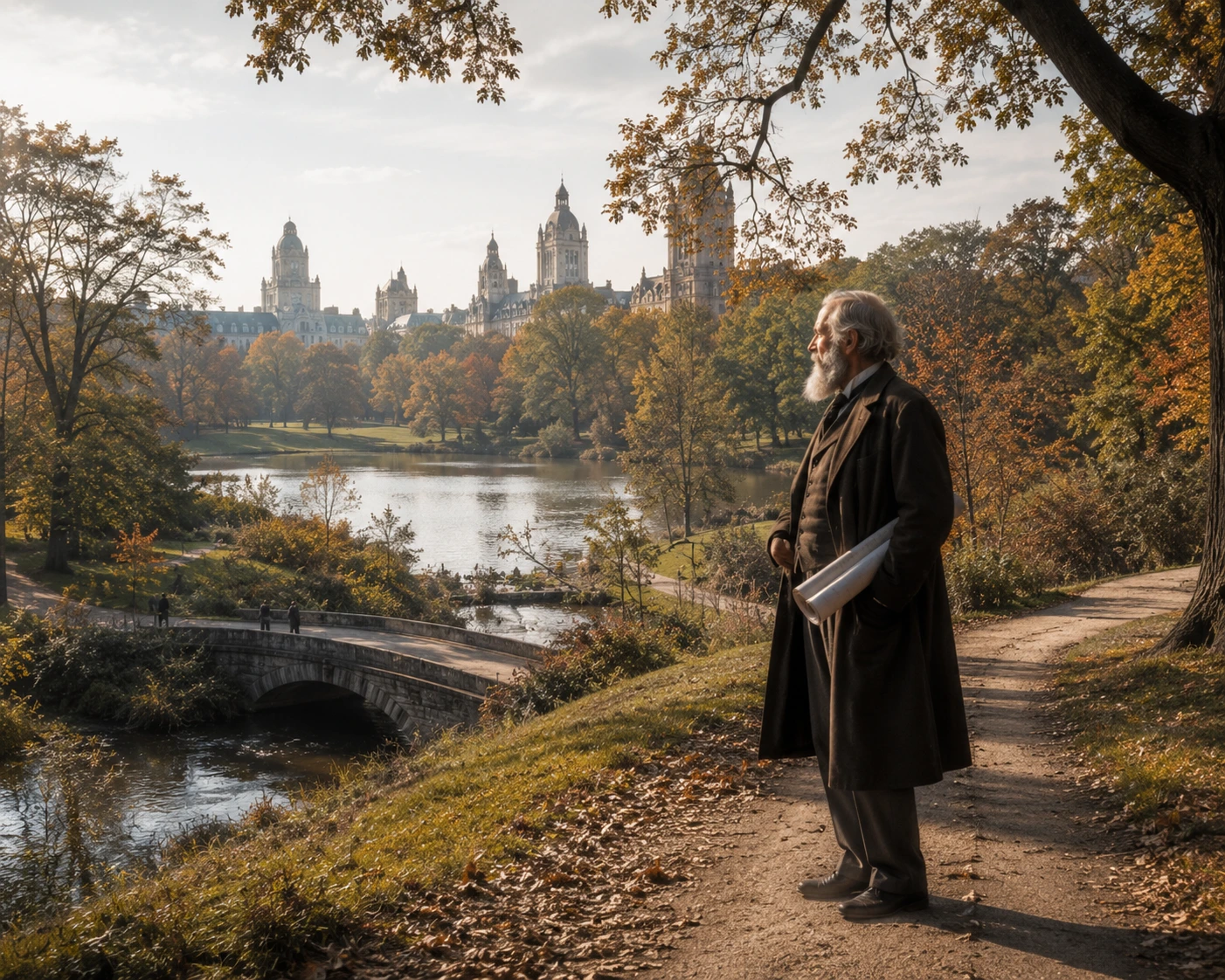
Central Park: the project that invented the modern public park
In 1857, the city of New York organised the first landscape design competition in the country for the development of a large central park. Olmsted won it with the British-born architect.Calvert Vaux: their project, the 'Greensward Plan', would become Central Park.
The Olmsted-Vaux duo did not design a simple ornamental garden. They composed a true landscape — vast lawns, woods, waterways, lakes — traversed by winding paths designed for strolling. Their stroke of genius: the sunken cross roads, which allow traffic to pass through the park without ever breaking the experience of the walker. A revolutionary idea for the time, and still studied today.
Central Park carries a political conviction as much as an aesthetic one: a large space of nature, in the heart of the city, belonging to all its inhabitants.
Much more than Central Park
The success of Central Park launched a career of nearly forty years. With Vaux, and then with his own agency, Olmsted designed Prospect Park in Brooklyn, the 'Emerald Necklace' — the chain of parks in Boston — the first coordinated system of parks and planted promenades in Buffalo, Mount Royal Park in Montreal, the spaces of the 1893 Chicago World's Fair, and the gardens surrounding the Capitol in Washington.
What strikes is the scale. Olmsted did not think of the park in isolation: he thought ofsystems— parks connected to each other by planted promenades, university campuses, residential neighbourhoods, natural sites to be preserved. He essentially invented the idea of designing the landscape on the scale of an entire city.
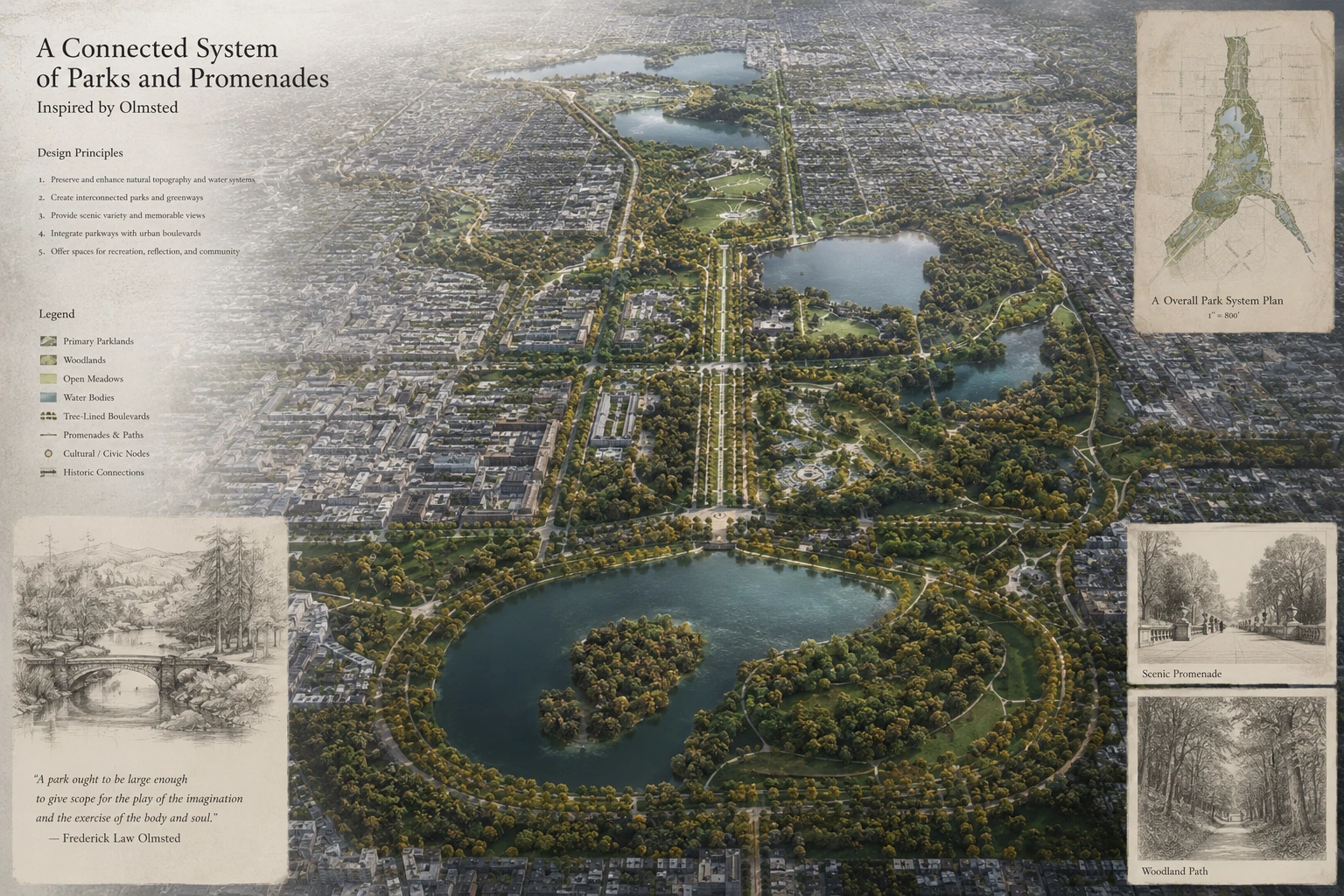
His great idea: nature in the city is not a luxury.
If Olmsted remains a reference, it is not only for his parks. It is for the idea that underpins them.
Olmsted was convinced of thehealing value of nature. At a time of significant urbanisation, he advocated the idea that contact with a soothing landscape is not a superfluous luxury, but a necessity for the health and balance of the inhabitants. The public park was not for him a decoration of the city: it was a vital organ, just like a hospital or a school.
He also paid rare attention to the place itself — to what is sometimes called the 'genius of the place'. Rather than imposing a style, he sought to reveal and amplify the unique character of each site.
What Olmsted's legacy inspires in us
Olmsted thought on the scale of cities. But his conviction is equally valid on the scale of a garden.
That a garden should not be a mere decoration, but a space that benefits those who inhabit it; that it should be designed starting from the character of the place rather than from a catalogue of styles: this is exactly the approach of a well-executed residential garden project. At Vert Val, the landscape architecture office founded by Lorenzo del Marmol in La Hulpe, this is the logic we apply to private gardens in Brabant Wallon and Brussels — an outdoor space designed for your well-being, and attuned to your site.
Olmsted did not only create large parks. He founded a profession — ours — around a simple idea: to live well is also to live close to nature.
Frequently Asked Questions
Why is Frederick Law Olmsted famous?
Frederick Law Olmsted (1822-1903) is considered the father of modern landscape architecture: he defined and named the profession. He is best known for designing Central Park in New York, as well as many public parks and park systems in the United States and Canada.
Did Olmsted design Central Park alone?
No. Central Park was born from the "Greensward Plan", the project that Olmsted designed with architect Calvert Vaux, which won the New York City planning competition in 1857-1858.
What are the other famous parks designed by Frederick Law Olmsted?
In addition to Central Park, he is also credited with Prospect Park in Brooklyn, the "Emerald Necklace" in Boston, the Buffalo park system, Mount Royal Park in Montreal, and the designs for the 1893 Chicago World's Fair.
What was Olmsted's great idea about parks?
Olmsted advocated for the restorative value of nature: for him, access to a calming landscape in the city was not a luxury, but a necessity for the health and well-being of residents. The public park should belong to everyone.
In summary
Frederick Law Olmsted did much more than design beautiful parks: he founded a profession and championed an idea that is still relevant today — that of a landscape designed for the well-being of people, and in harmony with the character of its place. It is this requirement that we bring to your project.