
James Corner: from the High Line in New York to contemporary gardens — the thinking of post-industrial landscape
If a single achievement from the last twenty years has transformed the way we think about urban landscape in the world, it is probably theHigh Linein New York: a 2.4-kilometre linear park built on a former elevated railway line running through Manhattan. Opened in several phases between 2009 and 2019, it now welcomes over 8 million visitors a year. Behind this project, and behind dozens of others that have since spread across Europe, Asia, and America, is one name:James Corner, landscape architect, theorist, founder of the agencyJames Corner Field Operations.
Winner of theSir Geoffrey Jellicoe Award in 2024— the highest global distinction in landscape architecture — Corner is also one of the major theorists of the discipline. He is the inventor of the concept of‘landscape urbanism’, which transformed the profession in the 2000s. This article sets the record straight — the article circulating online about Umilys contains several errors — and draws from his method some useful principles for a private garden in Belgium.
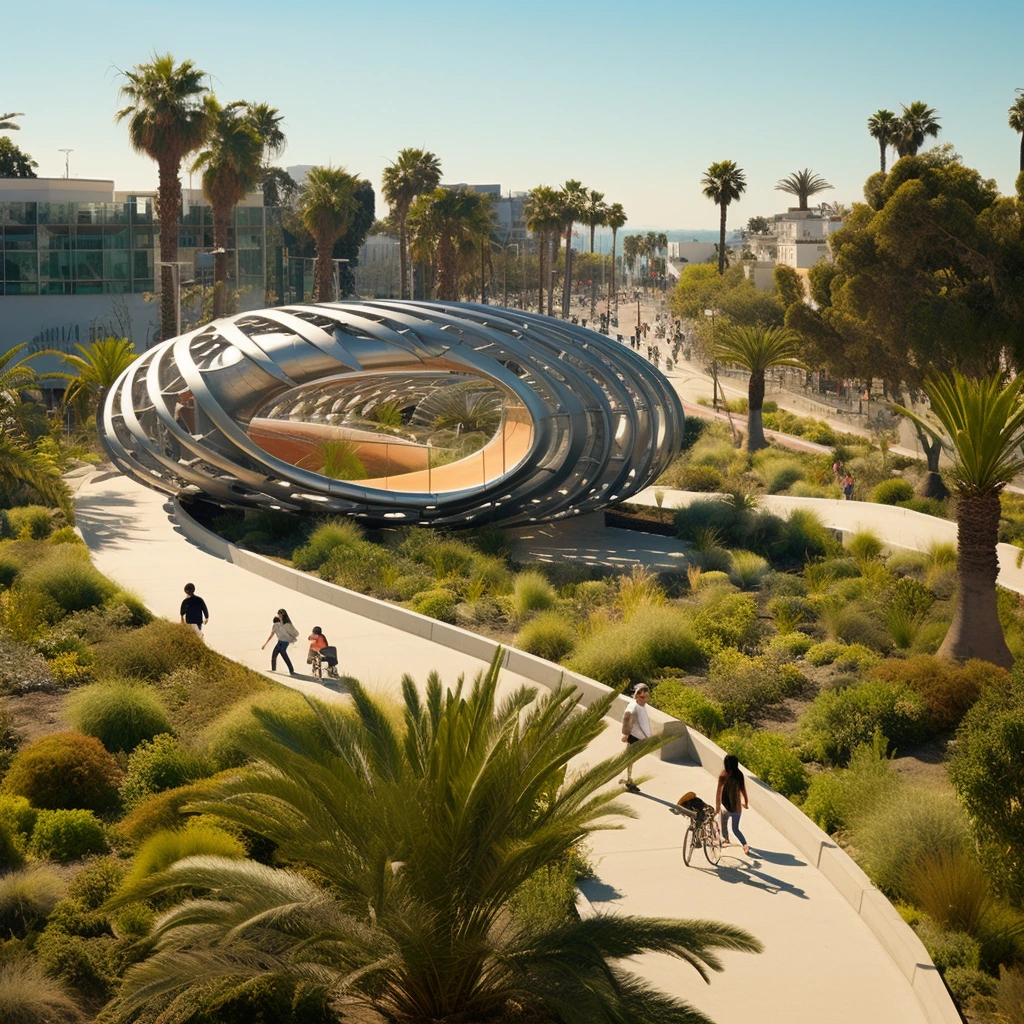
A journey: from Preston in England to New York
James Corner was born on 27 December 1961 inPreston, in the United Kingdom — not in New York as is sometimes read. He grew up there and studied landscape architecture atManchester Metropolitan University, from which he graduated with honours in 1983.
He then crosses the Atlantic to the prestigiousUniversity of Pennsylvania(Philadelphia) — often abbreviated to Penn, not to be confused with Princeton — where he obtained a Master of Landscape Architecture and an Urban Design Certificate in 1986. At that time, Penn was the flagship department of American landscape, previously headed byIan McHarg, author of the foundational bookDesign with Nature(1969). It is within this ecological lineage that Corner is trained.
Before founding his own practice, he gained very international practical experience between 1982 and 1988:
• Wallace, Roberts & Todd(Philadelphia): the redevelopment of the Hudson River waterfront in New Jersey;
• Richard Rogers and Partners(London): the redevelopment of the Royal Docks;
• William Gillespie and Partners(Liverpool): the International Garden Festival Park.
This experience explains his very transcontinental approach: he is familiar with British methods (English heritage, attention to thegenius loci), American (scale, urban engineering), and the ecological thinking of Penn.
Penn, teaching and practice
In 1988, at the age of 27, he began teaching at Penn, where he would remain for thirty years. He was electedchair of the landscape architecture department in 2000.— a position he held until 2012, thus following in the footsteps of McHarg, whose academic role he reprises. He is still a professor at Penn today.
On the practical side, it was in1998that he founded Field Operations, initially in collaboration with architect Stan Allen. The two partners separated in 2005, and the firm becameJames Corner Field Operations(headquartered in New York, with offices in San Francisco, London, and Shenzhen). It is this firm that carries out most of Corner's well-known works.
His big idea: "landscape urbanism"
To understand Corner, one must grasp the idea that made him known even before his projects: thelandscape urbanism— which could be imperfectly translated as "landscape urbanism." The idea, which he develops in his bookRecovering Landscape(1999), is as simple to articulate as it is radical in its consequences:
In contemporary cities, it is no longer architecture that structures the territory, but the landscape. Roads, railways, rivers, and green spaces form the backbone of urban life. The landscape architect is therefore no longer the decorator of residual spaces — he is the architect of the city itself.
This inversion is fundamental. For two centuries, it was said:first we build, then we plant.. Corner argues the opposite:first we think about the landscape, then we build within that framework.. This idea has spread: most of the major urban projects of the 21st century (Seattle waterfront, repurposing of old railway lines in Europe, Hudson Yards in New York, Olympic Park in London) are marked by it.
Three principles arise from this:
1.The post-industrial landscape as material.Where others see ruins, Corner sees anopportunity.. An abandoned railway, a polluted industrial site, a landfill — all places to be reinvented as landscapes.
2.Ecology as infrastructure.Vegetation is not a decoration: it is aliving infrastructurethat regulates climate, water, biodiversity, and urban health. This thinking predates current city climate adaptation policies by fifteen years.
3.The process rather than the form.A landscape is not a frozen image: it is aprocess over time.. It is designed to evolve, mature, and change with the seasons and decades — not to be beautiful on the day of the inauguration.
Five projects that have changed the profession
1. The High Line, New York (2009-2019) — the icon.
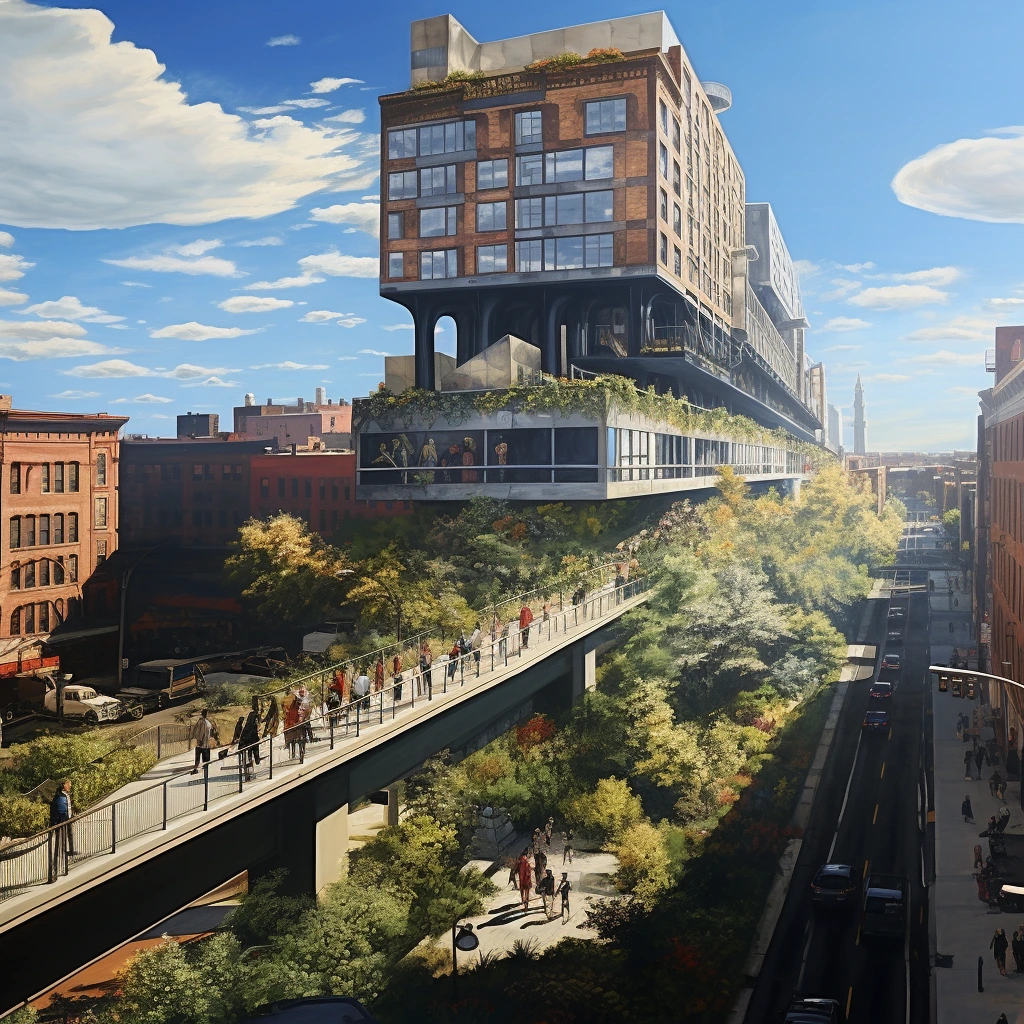
In 2003-2004, the city of New York launched an international competition to transform an abandoned elevated railway — the High Line, opened in 1934 for freight transport, abandoned since the 1980s — into a public park. Field Operations (lead) won the competition in collaboration withDiller Scofidio + Renfro(architecture) andPiet Oudolf(the great Dutch specialist in perennial and grass plantings, which we will discuss further on).
The figures:
• 2.4 km long, 22 blocks crossed, 28,800 m² of surface area
• More than 350 plant species, selected by Piet Oudolf to evoke the spontaneous flora that had colonised the route after its abandonment
• Phase 1 opened in June 2009, phase 2 in 2011, phase 3 in 2014, the Spur in 2019, the Moynihan Connector in 2023
• More than 8 million visitors per year today
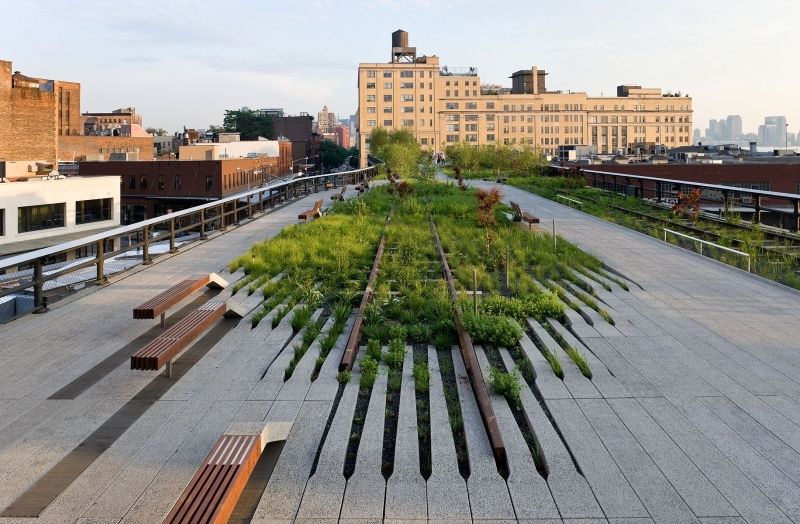
The conceptual innovation of Corner and his team is summarised by a word he invented:“agri-tecture”— half agriculture, half architecture. The ground of the park is designed as acontinuous gradientthat transitions from 100% mineral (concrete slabs) to 100% plant, throughprefabricated concrete boardsthat fray at their ends to allow plants to grow between them. The result is a walkway that resembles nothing else — neither a pavement, nor a lawn, nor a classic garden.
The urban impact is unprecedented: the High Line alone has triggered the construction ofmore than 27 new residential towers, hotels and officesaround the route. No other contemporary park has generated such real estate appreciation.
2. Fresh Kills Park, Staten Island, New York (2008-present)
Before the High Line, it was this project that made Corner known.Fresh Killswas the largest open-air landfill in the world, closed in 2001. Corner won in 2003 the competition to transform this site of890 hectares (almost three times the size of Central Park)into a public park — a titanic project that spans thirty years, with a gradual opening that began in 2012 and is still ongoing.
The project, titled"Lifescape", combines decontamination, reintroduction of ecosystems, water management, and the gradual creation of public uses. It is the practical manifesto of landscape urbanism: we do not create a park, we transform a territory.
3. Domino Park, Brooklyn (2018)
On the banks of the East River, Field Operations transforms the former Domino sugar refinery — closed in 2004 — into a neighbourhood park of2.4 hectares. The industrial DNA is preserved:21 steel columnsrecovered from the factory,endless screws and monumental gearsstaged as urban furniture. The project perfectly illustrates Corner's method:we do not clean the past, we transform it into a narrative.
4. Tongva Park, Santa Monica, California (2013)
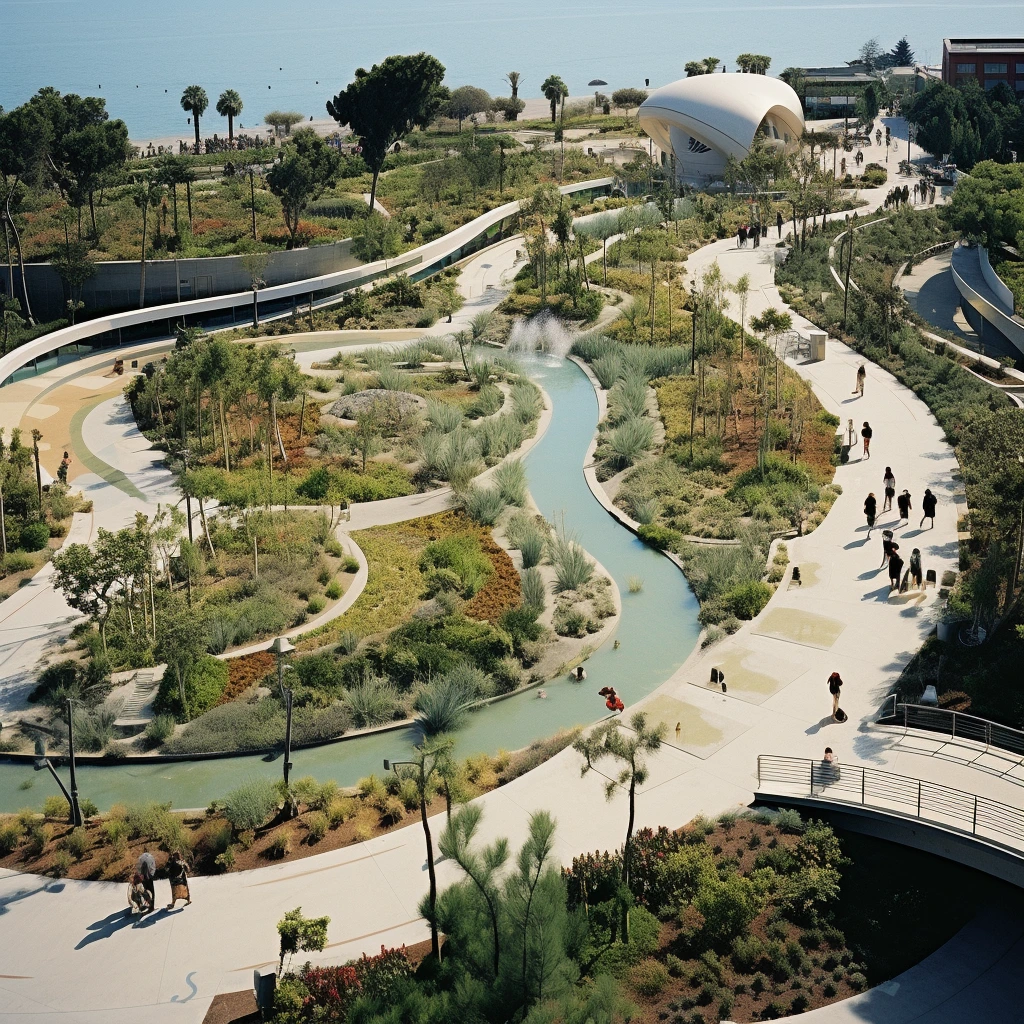
On 2.4 hectares in the heart of Santa Monica, Corner designs a park in tribute to the Tongva people, the first inhabitants of the Los Angeles basin. The geometry is more pronounced than on the High Line: winding paths,planted moundsthat evoke the Californian hills,tiered water features, integrated playground. It is one of the few projects by Corner on a site without industrial heritage — it shows that he can alsocompose a landscape from nothing.
5. The Seattle Central Waterfront (2010-2024)
When Seattle decides to demolish its elevated highway — the Alaskan Way Viaduct — which has separated the city from the sea since the 1950s, it is Field Operations that is chosen tostitch together 32 hectares of waterfront. The project, delivered progressively between 2017 and 2024, includes a promenade, public spaces, ferries, cultural facilities (including the renovation of Pike Place Market). It is one of the largest operations ofremoval urbanism— when the demolition of an infrastructure frees up a territory — of the 21st century.
Other major projects: theSouth Park of the Queen Elizabeth Olympic Parkin London (2014, after the 2012 Olympics), theNavy Pierin Chicago (2016),Shelby Farms Parkin Memphis (1,600 acres), and the master plan forQianhaiin Shenzhen (China).
A career at the top of the profession
• Architecture Award from the American Academy of Arts and Letters (2004)
• New York City Arts Commission Award for Excellence in Design (2005)
• Cooper Hewitt National Design Award (2010)— the highest American distinction in design.
• D&AD Black Pencil Award (2010)— the British equivalent of the Pulitzer in design, awarded for the High Line.
• Honorary Doctorate from the Technical University of Munich (2018)— Corner is thefirst landscape architect in historyto receive this distinction from TU Munich.
• ASLA Design Medal (2023)— the highest award from the American Society of Landscape Architects for an individual.
• Sir Geoffrey Jellicoe Award (2024)— the highest global distinction in landscape architecture, created by the International Federation of Landscape Architects (IFLA). Corner receives this award almost twenty years after Peter Walker, the first laureate in 2005.
In addition to this, his theoretical contributions include:Recovering Landscape (1999),Taking Measures Across the American Landscape (1996, with aerial photographer Alex MacLean), andTaking Measures Across the American Landscape (1996, avec le photographe aérien Alex MacLean), et The Landscape Imagination (2014). These books are studied in landscape architecture schools around the world. (2014). Ces livres sont étudiés dans toutes les écoles d’architecture du paysage du monde.
The travelling companion: Piet Oudolf and the grass palette
One cannot talk about the High Line without mentioningPiet Oudolf, a Dutch landscape architect born in 1944, the world master of the‘new perennial movement’— an approach to planting focused on grasses and perennials, inspired by the natural prairies of Central Europe and North America.
The success of the High Line is due as much to the infrastructure designed by Field Operations as to theplanting plan by Oudolf : with over 350 species. choisies pour évoquer la flore spontanée qui avait colonisé la voie pendant ses 25 ans d’abandon. L’ensemble varie radicalement selon les saisons : verts vifs au printemps, floraison ondulante en été, séchage doré en automne, silhouettes graphiques en hiver.
For a garden in Brabant Wallon, this is a crucial reference:Oudolf's palette works very well in our climate.. The grasses he favours (Calamagrostis, Molinia, Deschampsia, Panicum) are perfectly hardy in Belgium, and the perennials (Echinacea, Sedum, Geranium, Salvia, Eupatorium, Verbena bonariensis) tolerate our clay soils and humidity.
What the Corner method brings to a private Belgian garden
Corner designs for hectares, not for gardens. But his principles are surprisingly translatable — perhaps more so than those of more traditional landscapers. Here is what we regularly apply with our clients who want a gardencontemporary, alive, that evolves over time..
4.Accept the existing — including its traces.The great reversal of Corner: we do not start from scratch. An old brick wall, a cracked concrete slab, a twisted tree, an old water pump — all of this can become an asset of the garden. The rule is:what is there tells a story, and this story adds value to the place.In La Hulpe or Lasne, on old properties, it is almost always worthwhile.
5. Travaillez en gradient, pas en zones nettes. L’idée d’« agri-tecture »from the High Line can be applied to any terrace: instead of brutally separating the mineral (blue stone terrace) from the plant (mass), one cangradually degrade— spaced paving stones where thyme and sagina grow, planted joints, blurred edges. The result is more natural, more tactile, and ages better.
6.Adopt the palette of grasses and perennials.The great lesson from Oudolf applied at home: fewer spectacular short-lived flowers, moreplant structure that lasts six to nine months a year. For a garden in Brabant Wallon, a combination that works:Calamagrostis 'Karl Foerster'(vertical grass),Echinacea purpurea, Eupatorium maculatum 'Atropurpureum', Verbena bonariensis, Salvia nemorosa, Sedum 'Matrona'. Planted in masses of 20 to 50 plants per species, the effect is spectacular.
7.Think long term.Corner rejects the idea of the 'finished' garden: for him, a project isa trajectory of 5, 10, 30 years. In practical terms: do not plant for maximum effect in 12 months. Plant knowing thata tree takes 15 to 30 years to reach its mature form, and that this growth is part of the pleasure. Choose accordingly: a large central tree, planted young, will give you much more than three decorative trees bought in 100-litre pots.
8.The garden as ecological infrastructure.The Corner lesson: your garden is not just a decoration, it is anecological function— management of rainwater, a refuge for pollinating insects, a micro-climate around the house, CO₂ capture. For a 500 m² garden in Brabant Wallon, this can mean: a planted swale to absorb roof water, a 50 m² flower meadow for pollinators, active compost, native hedges for birds. These choicesdo not cost more, they create a more vibrant garden.
Corner in relation to other schools: where to place it?
To place Corner in the galaxy of contemporary landscapers, a quick comparison with the approaches we have covered elsewhere helps clarify the choices.
• Sgard (France):the grand landscape, soil thinking, regional planning.More urbanistic and structural.
• Halprin (USA):urban choreography, tactile water, citizen participation.More social and experiential.
• Walker (USA):geometric minimalism, restricted palette, raw materials.More abstract and plastic.
• Wirtz / Dhont (Belgium):the Flemish garden, massed evergreens, softened geometric structure.More classic and suited to our regional tradition.
• Corner (USA / UK):the post-industrial, grasses and perennials, ecology as infrastructure, long-term thinking.More contemporary, more ecological, more narrative.
For a residential garden in Belgium, the Corner philosophy aligns particularly well with the Wirtz legacy:rigorous Flemish structure + masses of grasses in the Oudolf style= a contemporary garden, rooted in our regional tradition and current ecological issues. This is precisely the combination we offer to many of our clients in Walloon Brabant.
Frequently Asked Questions
Is the High Line open to visitors?
Yes, freely and free of charge, all year round. Three main entrances: Gansevoort Street (south), 14th Street, 23rd Street. Allow 1.5 to 2 hours to walk the 2.4 km in one direction. The best time for vegetation is:June (spring flowering), September-October (grasses in full form and golden light). Avoid weekend afternoons in the height of summer: the park is crowded.
Is the Corner method suitable for a small city garden?
Yes, provided the scale is adapted. On 100 m², you don't need 350 species — you can make do with 8 to 12 well-chosen varieties, planted in masses. Theagri-tecture(mineral/vegetal gradient) works particularly well in small spaces, as it avoids the binary reading of "terrace + bed" that fragments the space.
Should grasses be planted everywhere?
No. Grasses are fantastic for thevertical structure, movement, winter, but they should be combined withperennials and structural shrubs.to give volume and depth. A good ‘Oudolf-style’ palette typically includes30-40% grasses, 50-60% perennials, 10-20% structural shrubs.
Is chic post-industrial compatible with a classic brick house?
Better than that: it is oftenparticularly successful. The contrast between a 19th-century brick manor house and a contemporary Oudolf-Corner garden creates an elegant tension. Many properties in the south of Brussels — Uccle, Watermael-Boitsfort, Auderghem — lend themselves beautifully to this. The trap to avoid: the falsely industrial pastiche (corten steel everywhere, raw concrete panels for no reason). Post-industrial is not a decorative style; it is a logic ofrespect for the heritage of the place.
What is the difference between Corner and Piet Oudolf?
Corner designs the infrastructure, the spatial organisation, the narrative. Oudolf composes the plant palette. On the High Line, they collaborated: Corner designed the framework in concrete slabs, the transitions, the uses; Oudolf selected and arranged the 350+ species. For a private garden, Oudolf alone may suffice if the infrastructure already exists. Corner without Oudolf remains more mineral, more urban.
Conclusion: landscape as narrative, not as decor
If we had to summarise James Corner's contribution in one sentence, it would be this:landscape is not a decor but a narrative. A narrative that is built with the site's past, with the ongoing ecological processes, with the long span of plant growth. This thought, theorised in the 1990s, put into practice with the High Line from 2009, has become in twenty years the dominant grammar of contemporary landscape.
For a residential garden in Belgium, the lesson is simple to articulate but demanding to apply:look at what your site gives you, choose a plant palette that speaks to you of the decades to come, and accept that the garden is made as much as it is designed.. This is what we try to convey to each of our clients who call us for a contemporary project.