
Lawrence Halprin: the landscape architect who taught cities to dance
When asked to name the most important American landscape architect of the 20th century, landscape architecture students almost always mention two names: Frederick Law Olmsted, the designer of Central Park in the 19th century, andLawrence Halprin, the man who redefined urban landscape in the second half of the 20th century.
Born in New York in 1916 and died in San Francisco in 2009, Halprin left behind a surprisingly coherent body of work, ranging from the Franklin D. Roosevelt Memorial in Washington to forgotten squares above urban highways. His influence extends far beyond the United States: any landscape architect today who reflects on the role of water, movement, and citizen participation in urban design is, whether they know it or not, an heir of Halprin.
Why talk about it from La Hulpe? Because his method —designing a space like a score, so that it can be inhabited with the body— works equally well for a public square of 5,000 m² as for a private garden of 200 m². We will return to this at the end of the article with some concrete principles.
A journey that goes through dance, horticulture, and the Bauhaus
Lawrence Halprin was born on 1st July 1916 in New York and grew up in Brooklyn. As a teenager, he spent three years in a kibbutz near Haifa, in Mandatory Palestine — a communal experience that would profoundly shape his thinking about the collective and shared space.
His training is deliberately eclectic:
• 1935-1939:Bachelor of Science in Plant Sciences at Cornell University (Ithaca, NY).
• 1939-1941:Master of Science in Horticulture at the University of Wisconsin (Madison). It was there, while visiting Taliesin East, the studio-home of Frank Lloyd Wright, that he decided to pivot towards design.
• 1942:Bachelor of Landscape Architecture at the Harvard Graduate School of Design, where he studied underWalter Gropius, Marcel Breuer(the two German founders of the Bauhaus exiled in the United States) andChristopher Tunnard— the latter's book,Gardens in the Modern Landscape(1938), would have a decisive influence on him.
This dual training — first as a horticulturist, then as a designer, with Bauhaus modernism as a backdrop — explains his uniqueness. Halprin knows plants, but he thinks like an architect; and even more so, he thinks like a choreographer.
The marriage that changes everything
In 1940, he marriesAnna Schuman, a dancer and future avant-garde choreographer under the name of Anna Halprin. The couple settles near San Francisco in 1945, and the creative dialogue that develops there is one of the keys to understanding Lawrence's work. His wife sees dance as a journey through space; he sees space as a journey for the body. In 1954, he designs an outdoor dance platform (the 'deck') where Anna establishes the San Francisco Dancers' Workshop, which will become one of the artistic centres of the West Coast.
This interaction will nourish his entire career: Halprin is one of the very few landscape architects to have explicitly integrated thechoreographic notationinto his design method.
His true innovation: the RSVP Cycles
Many articles present Halprin as the inventor of "participatory design" — the design that involves residents in the process. This is true, but it is reductive. His deepest contribution is a system of thought that he published in 1969 in the bookThe RSVP Cycles: Creative Processes in the Human Environment, developed with Anna Halprin and architect Jim Burns.
RSVP is an acronym:
• Resources — what we have: materials, plants, budget, site constraints
• Scores — the "score": the plan, the usage scenario, what is expected to happen in the space
• Valuation — critical feedback, ongoing adjustment
• Performance — the actual use, what happens when people appropriate the space
For Halprin,every human activity is based on a score— from the garden to the shopping list, through a calendar or a visitor's route. This framework transformed his practice: before imagining the form, he imagined the experience. This is why his places age well: they are designed as scenarios, not as backdrops.
Five works that changed the urban landscape
1. The Donnell Garden, Sonoma (1948) — the formation
Before opening his agency, Halprin worked for four years (1945-1949) atThomas Church, the great modern Californian landscape architect. He participated in the design of the Dewey Donnell garden in Sonoma — famous for itsfreeform poolwhose silhouette has become the icon of 'California modernism'. It is the practical school that shapes him: respect for the site, working with the dry climate, the use of local species.
2. Ghirardelli Square, San Francisco (1962-1968) — the precursor of urban recycling
When the old Ghirardelli chocolate factory, on the waterfront of San Francisco, is threatened with demolition, the Halprin agency transforms the industrial complex into a lively public square. Shops, restaurants, central fountain, terraced stairs: it is one of thevery first global examples of industrial rehabilitation, thirty years before the concept became common. The model will inspire projects on all continents — including in Belgium, where the conversion of old breweries or factories into living spaces bears witness to this.
3. The sequence of public spaces in Portland, Oregon (1965-1978)
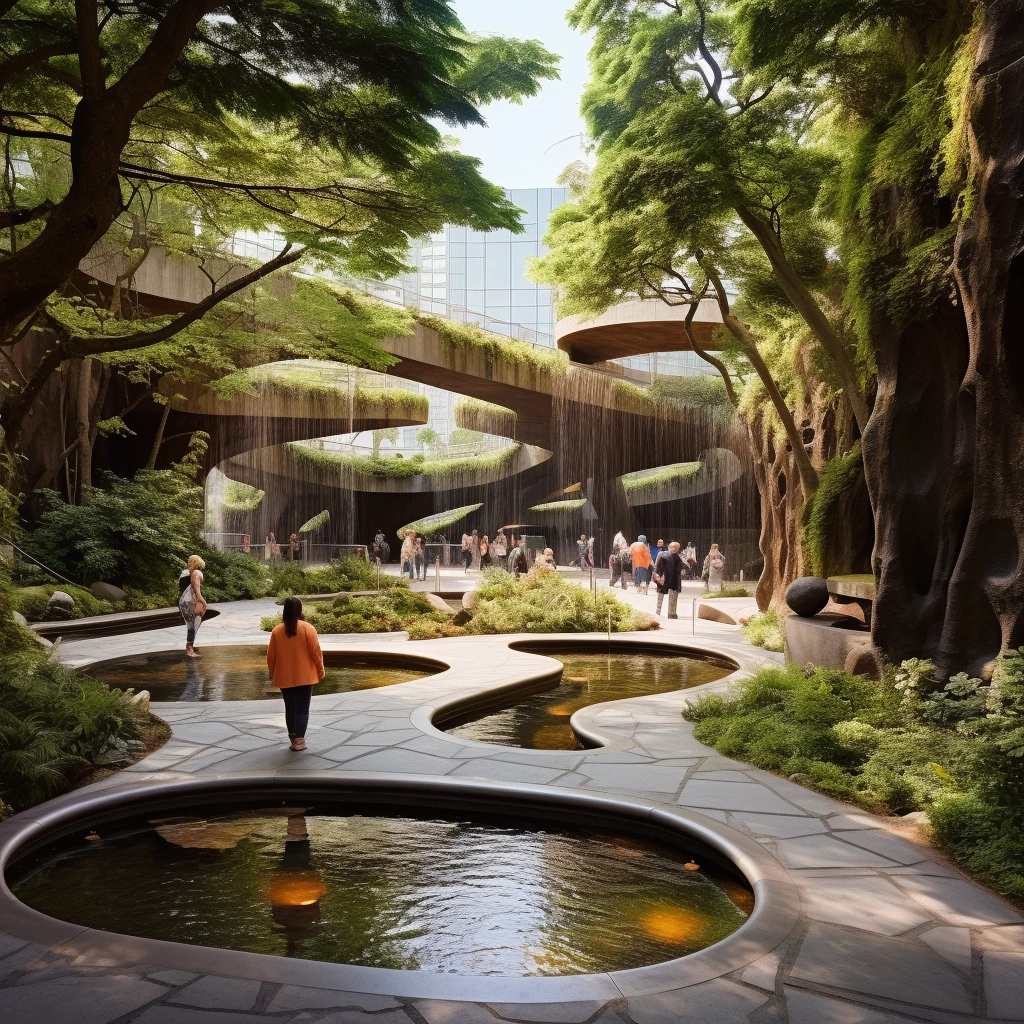
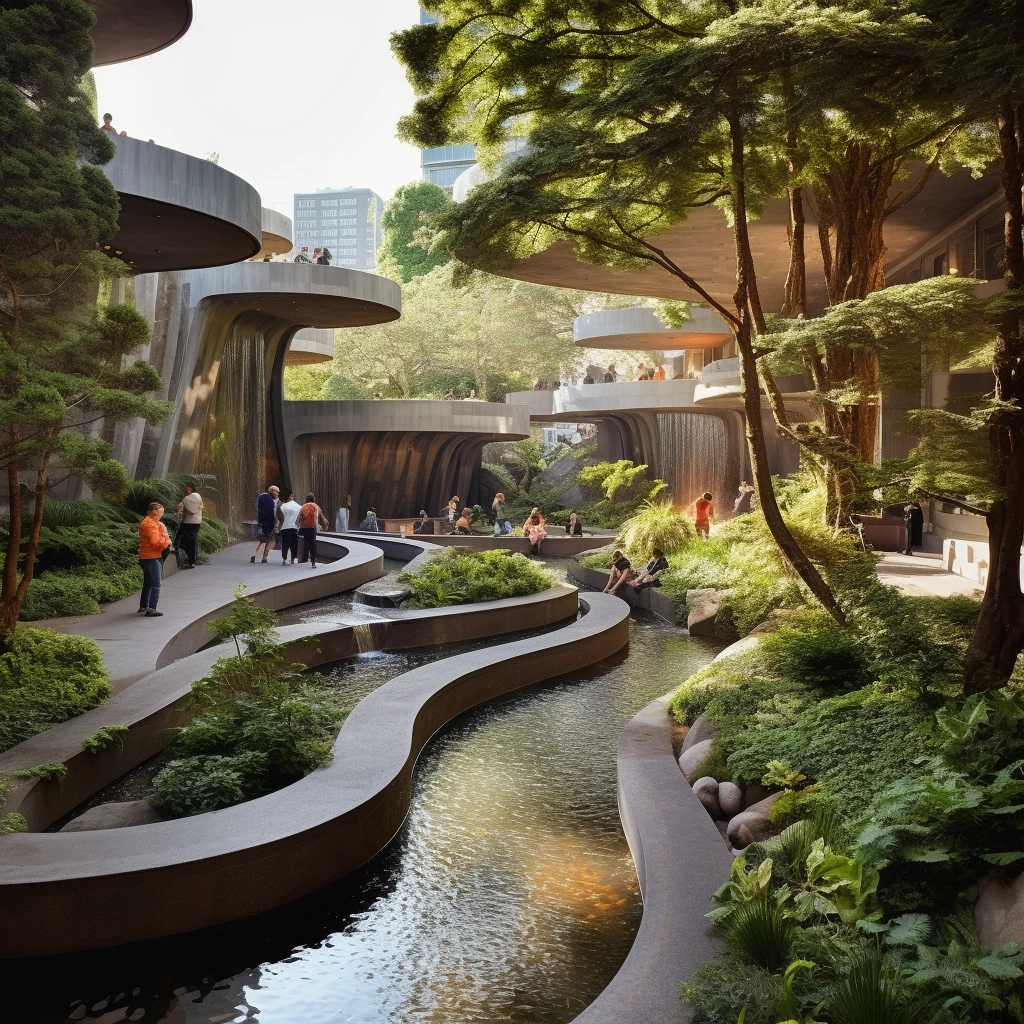
In Portland, Halprin designs aconnected sequenceof four public spaces — Lovejoy Plaza, Pettygrove Park, Auditorium Forecourt (now Keller Fountain) and the Transit Mall. It is the most accomplished application of his choreographic thinking: one traverses the city as if following a musical score, with strong moments (the monumental fountains, like urban waterfalls in raw concrete), soft moments (the shaded gardens), transitions.
The architecture critic of the New York TimesAda Louise Huxtablequalified the Portland Auditorium Forecourt as one of the most important urban spaces since the Renaissance — a compliment rarely given to a 20th-century project.
4. The Sea Ranch, California coast (1962-1967)
On 2,000 acres of Pacific coastline north of San Francisco, Halprin develops the master plan for amodel residential community.Instead of dividing the site into regular plots, he analyses the wind, erosion, indigenous vegetation, and imposes rules: houses grouped in clusters to protect each other, sloped roofs against the wind, a palette of materials and colours aligned with the landscape.
Sea Ranch is now considered a manifesto ofecological planning— twenty years before the term became fashionable. It is the antithesis of standard housing developments, and the model continues to be cited in urban planning schools around the world.
5. The Franklin D. Roosevelt Memorial, Washington D.C. (1974-1997)
Selected in 1974 by the memorial commission, Halprin envisions asequence of four outdoor rooms, one for each of Roosevelt's terms. Red granite from South Dakota (31,269 blocks), seven fountains totalling 100,000 gallons of circulating water, twenty-one quotes from Roosevelt engraved in stone, ten bronze sculptures (by Leonard Baskin, Neil Estern, Robert Graham, Thomas Hardy, George Segal).
Forty years between the creation of the commission (1955) and the inauguration by Bill Clinton on May 2, 1997. Halprin himself would describe this project asthe apotheosis of all that he had done. One of the major innovations of the memorial: it wasentirely designed for accessibility— Roosevelt himself being affected by polio — long before accessibility standards became widespread.
His signature: water, raw stone and movement
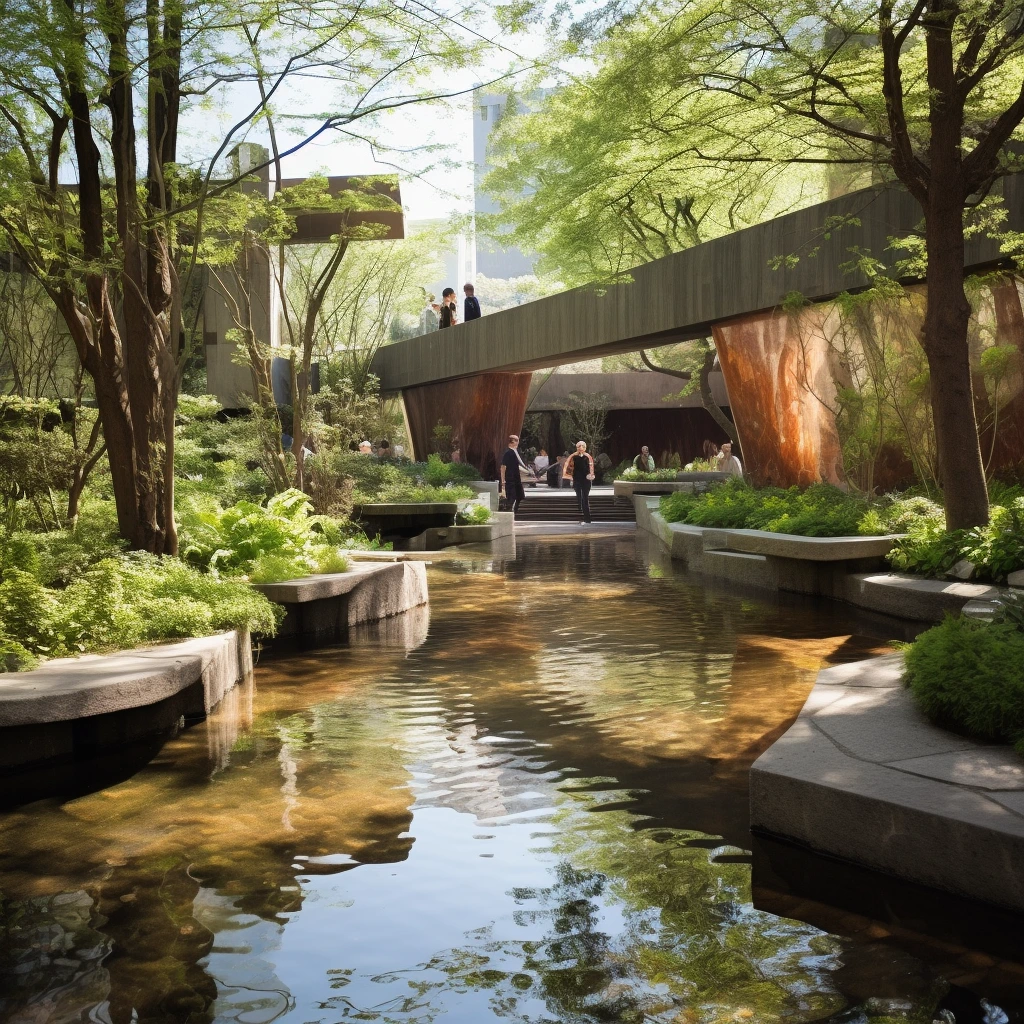
If one had to identify the recurring elements of his projects, they would be:
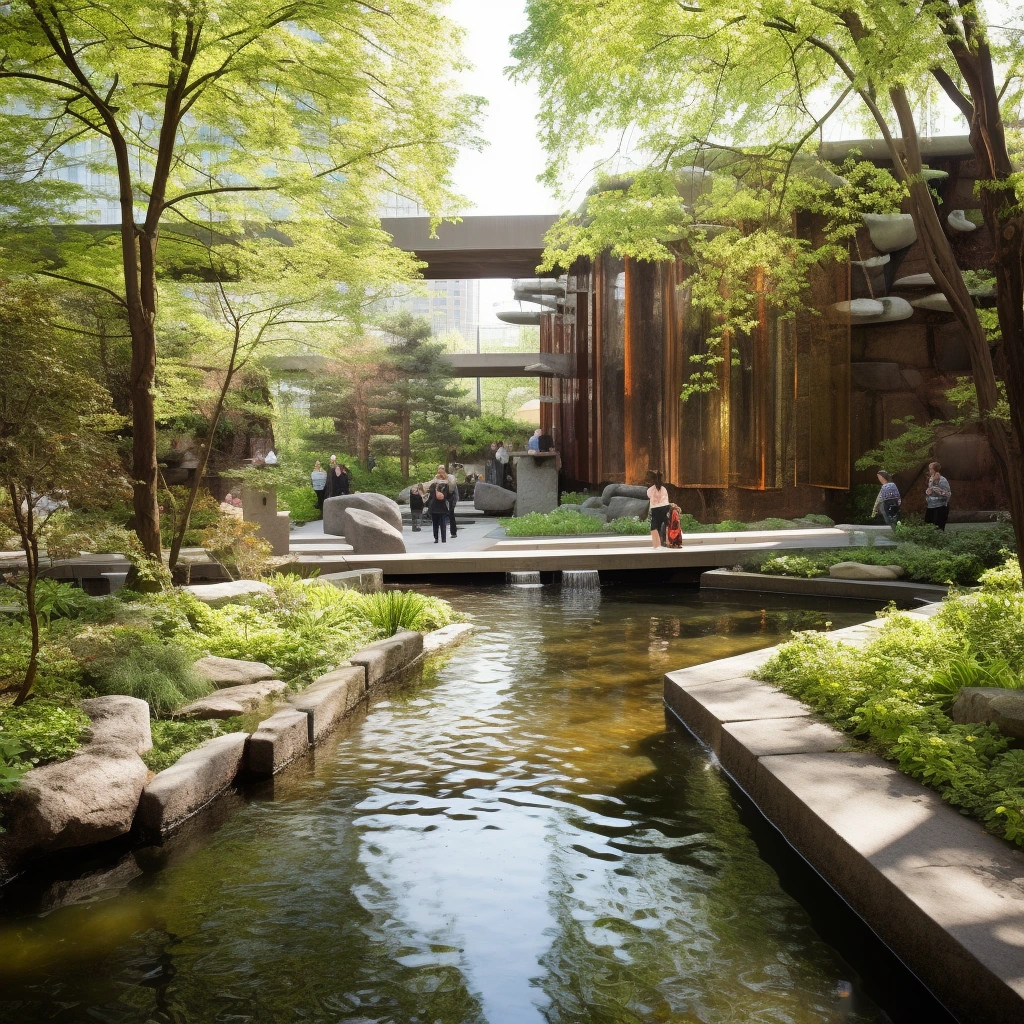
• Moving water,treated as a narrative and tactile element — not an ornament. Waterfalls, streams, splash pads: you come into contact, you sit on them, you cross through. Halprin often said that his fountains were an "experiential equivalent of nature".
• Raw stone and concrete,as mineral blocks that recall the original geology. In Portland as at the FDR Memorial, concrete is not a compromise — it is the material that gives power to the place.
• Spatial sequences,with moments of contraction and expansion. You never stay in the same type of space: you move from one "room" to another, like in a musical score.
• Indigenous vegetation,planted in readable masses rather than in horticultural compositions. Halprin was an ecologist before it was fashionable.
• The involvement of the future user,through participatory workshops (the famous "take-part workshops") where residents noted their daily movements, their discomforts, their desires. This data then fed into the "score".
A scene to understand: Portland, noon, in summer
Imagine a downtown square in Portland, at the foot of a theatre. Instead of a smooth granite forecourt with a few benches, there is an eight-metre high concrete waterfall, water cascading over sloping platforms, stairs plunging into the pool. Employees in suits eat their sandwiches with their feet in the water. Children cross the fountain, jumping from block to block. No one directs this choreography — and yet it was planned minute by minute, several years before the first concrete was poured.
This is the Auditorium Forecourt in Portland, now Keller Fountain. It is also, in a single scene,the entire Halprin method: design for use before decor, and accept that people will use the space in ways other than what was intended.
What we take away for our gardens in Walloon Brabant and Brussels
Halprin designed squares of several hectares, not private gardens. But his method is surprisingly transferable to a residential garden — perhaps more so than that of traditional landscape architects.
1.Think in terms of a score, not a plan.Before you draw, ask yourself what needsto happenin the garden: where do you have your morning coffee? Where do the children play? What path do you take when you come home tired? The garden is a scenario of use before it is a visual composition.
2.Give water a tactile role.Not a decorative pond in the middle of a lawn, but a water point by which one can sit, heard from the terrace, that refreshes the atmosphere in summer. On the clay soils of Brabant, a small pond with gently sloping banks attracts biodiversity much more effectively than a formal pond.
3.Work the sequences.Avoid the "garden seen at a glance". A low hedge, a change in level of 40 cm, a narrowed passage between two topiaries: these are all means to create expansion/contraction. The garden becomes largerbecause it is discovered in stages..
4.Embrace unintended use.Halprin said that "performance" (actual use) is as important as the "score" (the plan). If your children use your flower beds as obstacle courses, that is a success, not a failure. Design elements that are robust enough to absorb the unexpected.
5.Prioritise materials that age.Halprin liked raw concrete, granite, weathered wood — not for aesthetic reasons, but because these materials gain presence over time. For a Belgian garden, blue stone, reclaimed brick, and untreated oak play the same role.
Frequently asked questions
Did Halprin work in Europe?
Yes, but marginally. His most well-known European project is theHaas-Goldman promenade in Jerusalem, developed in the 1980s along the old city. He also received theFriedrich Ludwig von Sckell Ring of Honor in 2002.from the Bavarian Academy of Fine Arts, a rare distinction for an American. His ideas, however, profoundly influenced the European generation of the 1970s-1990s — including the Belgian landscape architects who introduced the urban fountain, the sequence of spaces, and the 'inhabited' square in our cities.
What distinguishes Halprin from Frederick Law Olmsted?
Olmsted, in the 19th century, invented the grand American landscape park (Central Park, Prospect Park, Mount Royal in Montreal) — a picturesque and romantic landscape that serves as an escape from the city.Halprin, in the 20th century, designed squares and fountains that arein the city and with the city.Olmsted recreates nature; Halprin reinterprets it at the heart of the mineral. The two philosophies are complementary, not opposed.. Olmsted recrée la nature ; Halprin la réinterprète au cœur du minéral. Les deux philosophies sont complémentaires, pas opposées.
Can we visit his works?
Most are freely accessible: the FDR Memorial in Washington (free entry), Ghirardelli Square in San Francisco, the public spaces of Portland. Sea Ranch is a private residential community, but the coastal trail runs through the site. If you pass through Washington, the FDR Memorial is one of the most significant visits on the National Mall — allow at least an hour to explore the four chambers.
Are the RSVP Cycles useful to an individual landscaping their garden?
Surprisingly yes — in a simplified form. Before embarking on a garden project, ask yourself:what are my resources (R) — land, budget, exposure? What programme (S) — what uses do I want to see there? How will I evaluate (V) whether it works in six months? And what will actually happen (P) once the garden is inhabited?This is exactly the framework we use on our first visit with our clients.
Conclusion: a legacy that transcends borders.
Lawrence Halprin received almost all the American distinctions in his profession during his lifetime: the Gold Medal from the ASLA in 1978, the Thomas Jefferson Medal in 1979, the National Medal of the Arts in 2002 — the highest American artistic distinction, awarded by the president. But his true legacy lies elsewhere: in thehundreds of landscape architects trained directly or indirectly in his method., and in the very simple idea that an outdoor space is not designed to be looked at, but to be experienced.
Whether you live in Watermael-Boitsfort, La Hulpe or Tervuren, and are considering the layout of your garden, this is exactly the question we will ask you first: not "how do you want it to look beautiful?", but"how do you want to experience it?"Beauty follows. Halprin understood this sixty years ago.