
If you had to name the American landscape architect who has most marked the first decade of the 21st century, one name comes up insistently:Peter Walker. Born in 1932 in California, still active today at over 90 years old at the head of the PWP Landscape Architecture agency (Berkeley), he is the co-designer of theNational September 11 Memorialin New York with architect Michael Arad, and the first recipient of thehighest global award in landscape architecture— the Sir Geoffrey Jellicoe Award, established in 2005 by the International Federation of Landscape Architects.
Critic Richard Brettell unequivocally describes him as the“dean of American landscape architects.”. And yet, his approach is surprisingly radical:fewer plants, but better; fewer elements, but more precise.This is what is called landscape minimalism — an approach whose principles are as relevant for a private garden of 200 m² in Brabant Wallon as for the seven hectares of the Memorial Plaza in Manhattan.
In this article, we revisit the true biographical markers (often confused online), the key works that are actually documented, and above all theconcrete principlesthat his method can bring to a private garden project in Belgium.
A journey: from Berkeley to Harvard, and from Halprin to Sasaki.
Peter Walker was born in Pasadena, California, in 1932. A child during the Great Depression, he was raised in Berkeley after the death of his father. He studied landscape architecture atUC Berkeley(B.S. 1955), at a time when the department was attached to the school of agriculture and provided a very scientific training — soils, plants, ecosystems. This solid botanical foundation would mark his entire career.
During his studies, he worked for two years (1954-1956) atLawrence Halprinin San Francisco — the great landscape architect whose portrait we have published elsewhere. It was in this office that he discovered the practice of modern landscaping. He then continued at Harvard, where he obtained hisMaster of Landscape Architecture in 1957, awarded the Jacob Weidenmann Prize.
At Harvard, he metHideo Sasaki, one of the great American modernists in landscape architecture. The two foundedSasaki, Walker and Associates in 1957, an agency that would becomeThe SWA Groupin 1973 — one of the most influential landscape architecture firms in the world, of which Walker was president until 1983.
The turning point of 1983: the birth of PWP
At 51, Walker left SWA and founded his own firm, which went through several names before establishing itself asPWP Landscape Architecturein 1997 (Berkeley, California). This agency, which he still leads today with about thirty collaborators, is responsible for the majority of his most well-known works.
During this period, Walker also taught at Harvard where he chaired theDepartment of landscape architecture from 1978 to 1981. It is in this dual role — designer and teacher — that he will structure a movement: theapproach to landscape as art, inspired by American minimalist artists such as Carl Andre, Donald Judd and Sol LeWitt.
Landscape minimalism: less, but better
Minimalism in the garden is often caricatured: one thinks of "white gravel, two pebbles, a Japanese pine". Walker has redefined it differently, and in a more demanding way.
"I love minimalism because it allows for a better view of natural processes. Without a mass of shrubs to obscure them, the arrival of spring, the falling of leaves, winter — everything becomes more evident. In a way, minimalism makes the plant material more present: it becomes the star of the composition. One of our principles is to use plants in a way that highlights them." — Peter Walker, PWP Landscape Architecture
Three principles structure his method:
1.Geometry as a revealer.Walker systematically uses theframework, the grid, alignmentto give a rigorous reading to a space. This geometric structure is not a cage: it is a frame that makes natural variations (light, seasons, growth) visible.
2.Raw material treated as such.Stones are stones, water is water, trees are trees. No picturesque, no historical citation, no decor. The material is staged for what it is, not for what it evokes.
3.The assumed influence of minimalist artists.Walker studied and engaged with the work of Carl Andre (sculptor of the "rugs" made of metal plates on the ground), Donald Judd (orthogonal aluminium boxes), and Sol LeWitt (repeated cubic structures). The connection between his gardens and their works is claimed:landscape is an art, and it shares its tools.
Five works that established his reputation
1. Tanner Fountain, Harvard University (1984) — the foundation
Commissioned by Harvard President, Derek Bok, who wanted a fountainwithout a basin(traditional basins always ended up, after a leak, being transformed into planters). Walker, in collaboration with sculptor Joan Brigham, delivered a radical device in 1984:159 blocks of granitearranged in concentric circles of 60 feet in diameter (≈ 18 m), embedded in the ground at bench height.32 nozzles hidden in the centreemit a fine mist from April to October; in winter, it is the steam from the central heating plant of the campus that takes over.
The result is an objectboth geometric and natural, devoid of specific purposes (one sits, one crosses, one plays, one contemplates), and which changes radically in appearance according to the season and the light. The Tanner Fountain is now considered thefirst institutional project of the "Landscape as Art" movementthat developed under Walker at Harvard. It received the Landmark Award from ASLA in 2008 — an honour reserved for projects that have maintained their integrity after more than twenty years.
2. The Nasher Sculpture Center Garden, Dallas (2003)
With the Italian architectRenzo Piano, Walker designs the garden of the Nasher Museum in Dallas — one of the largest modern sculpture museums in the world. The method is clear:rigorous paths of live oaks and elms, hedges of holly trimmed into walls, andstone plinthsthat serve as bases for the sculptures of Rodin, Calder, Henry Moore, Giacometti, Serra. The garden is not a backdrop for the works: it is agallery in the open airwhere the plant composition plays the role of a frame.
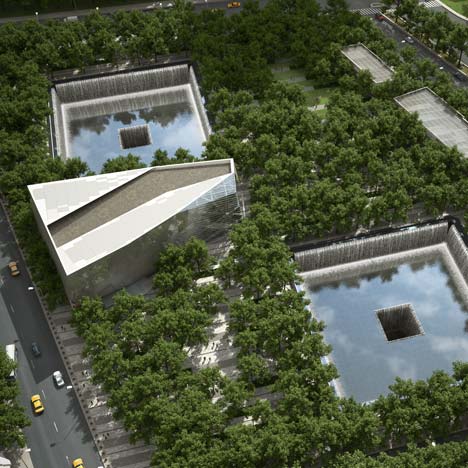
3. The National September 11 Memorial, New York (2003-2011)
Walker’s most well-known work. In 2003, the Lower Manhattan Development Corporation launched an international competition for the World Trade Center memorial:5,201 proposals received from 63 countries. In January 2004, the selected project is“ Reflecting Absence”, by Israeli-American architect Michael Arad — a then 34-year-old virtually unknown architect, employed by a New York City agency. The jury explicitly asks Arad to engage a leading landscape architect to humanise the project without diluting its radicality. Walker is the one chosen.
The strength of the project lies in two gestures:
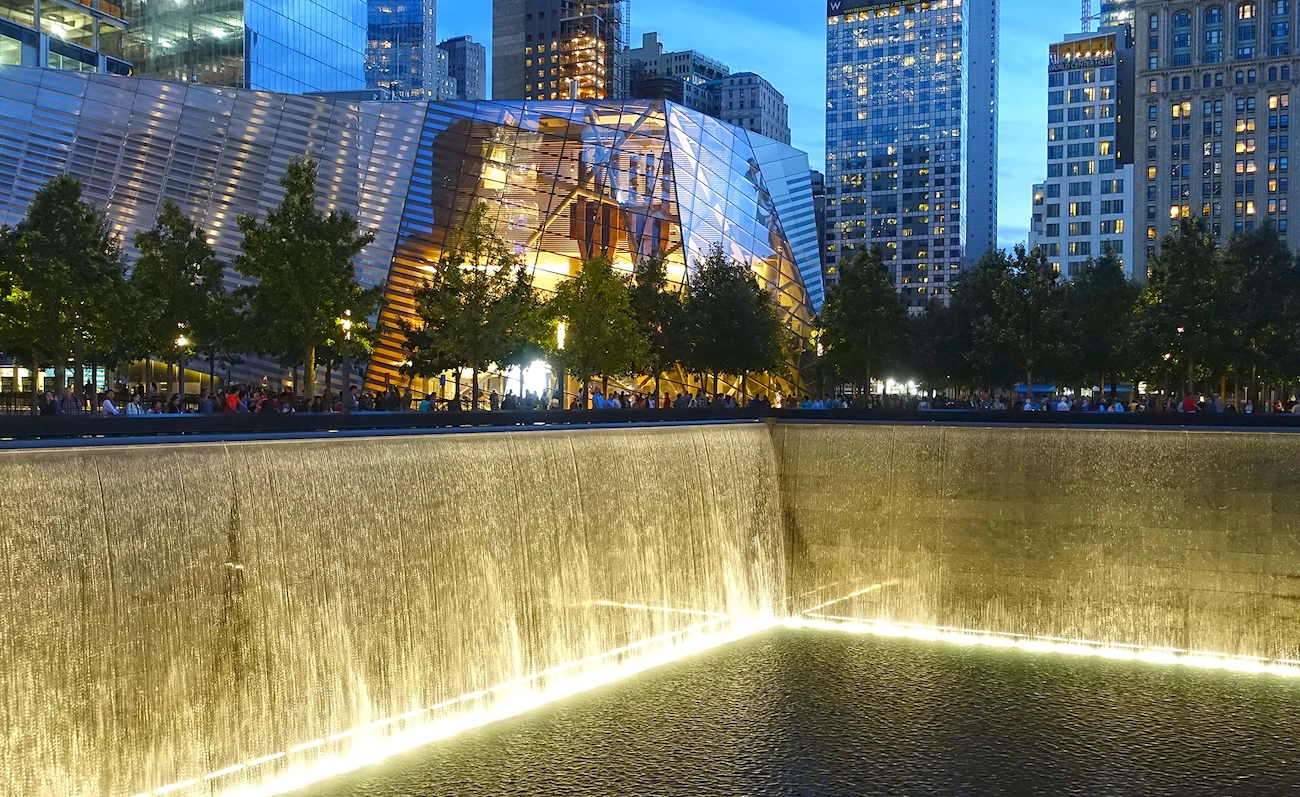
• Two square basinsexcavated at the exact site of the Twin Towers, each about 4,000 m². Water cascades down from a height of 9 metres — the, chacun d’environ 4 000 m². L’eau y tombe en cascades de 9 mètres — les largest artificial waterfalls in North America— before disappearing into a smaller central void. The names of nearly 3,000 victims are engraved in bronze on the parapets.
• A grid of over 400 swamp white oaks (Quercus bicolor) planted in the square around the pools. A native species found at all three attack sites (NYC, Pentagon, Shanksville in Pennsylvania), these trees reach 18 to 24 metres at maturity and live for 300 to 350 years. Their golden leaves in autumn, their bare silhouette in winter, their summer shade mark the memorial according to the seasons.
Walker explained that the layout of the trees was designed to appearrandom or perfectly aligned depending on the visitor's angle— a perceptual effect that directly recalls the research of sculptor Carl Andre. The plot also includes a« Survivor Tree »— a Chinese pear tree found burned on the site in October 2001, cared for for nine years by the NYC parks department, and replanted in 2010.
4. Pixar Animation Studios, Emeryville, California (2000)
The Pixar campus — created by Steve Jobs himself in 2000 — entrusts PWP with the outdoor spaces. Walker deploys his geometric grammar there:rigorous alignments of olive treesand cypress, orthogonal water features, structured banded lawns. The campus, which has become emblematic of the creative culture of Silicon Valley,owes as much to its landscape as to its architecture..
5. Glenstone Museum, Potomac, Maryland (2018)
Considered by some critics to be Walker's recent masterpiece, the campus ofGlenstoneis a private contemporary art museum set on 130 acres. Walker designed a succession ofmeditative landscapes— native prairies, groves, water features — articulated around the buildings of Thomas Phifer. The radicality is almost erased: it is the most advanced degree of his minimalism, wherecomposition disappears behind experience.
A career celebrated by the highest distinctions
To measure Walker's place in the profession, it is enough to list the awards he has received:
• Sir Geoffrey Jellicoe Award (2005) —thehighest global distinctionawarded to a landscape architect, created in 2005 by the International Federation of Landscape Architects (IFLA). Walker is itsvery first laureate.
• Cooper Hewitt National Design Award (2007) —in the United States, the equivalent of the Smithsonian for design.
• Honor Award from the American Institute of Architects— rare for a landscape architect.
• Thomas Jefferson Medal in Architecture, University of Virginia— the same distinction received by Lawrence Halprin before him.
• Centennial Medal from Harvard, Liberty Award from the Lower Manhattan Cultural Council (2012)for his work on the 9/11 Memorial.
• Richard Brettell Award in the Arts (2017)from the University of Texas at Dallas.
In total,over 70 regional, national and international awards. A career spanning seven decades — Walker continues to practice actively.
What the Walker method brings to a private Belgian garden
Walker designs for museums, memorials, corporate headquarters — not for gardens of 300 m² in Brabant Wallon. But his principles are remarkably transferable, and this is what we regularly apply with our clients who appreciate simplicity and rigor.
4.Choose 3 to 5 species, not 25.The classic trap of the private garden is collection: a bit of everything, everywhere. Walker does the opposite: herepeats the same species across dozens, sometimes hundreds of specimens, and achieves a mass effect that is never monotonous. For a garden in Brabant Wallon, this could result in: a hornbeam hedge, a yew grove, a line of birches, a mass of white panicle hydrangeas, a carpet of geranium 'Rozanne'. Five species, total clarity.
5.Think in grids before thinking in composition.A geometric framework — alignment of trees every 4 metres, modular paving, regular spacing of flower beds — gives the garden an immediate reading. The plants then come to fill, overflow, soften this grid —but it remains perceptible, especially in winter.
6.One single water feature, treated seriously.If you want water in your garden, do not scatter it: a fountain, a pond, or a marsh — just one, well placed, well sized. To draw inspiration from Walker, look at the Tanner Fountain:60 feet in diameter, 159 stones, 32 jets, and that’s it. No ornamentation, no decoration, no bronze cherub.
7.The seasons as a spectacle.The 'star' of the minimalist garden is the plants themselves. Choose specieswith strong seasonal variations: a spring-flowering dogwood + red winter bark, a red-leaved maple in autumn, grasses that come alive with the slightest breeze, hydrangeas that turn white and then brown as they dry. They are what make the garden, not the decor.
8.Bare materials, chosen with rigor.Walker uses granite, raw concrete, gravel, stone. No imitations, no haphazard mixtures. For a Belgian garden:blue stone(the 'small granite' from Hainaut), reclaimed brick if it matches the house, quality compacted gravel, untreated patinated wood. A maximum of three materials across the entire garden.
American minimalism or Flemish garden? A useful comparison
To situate Walker's method within the Belgian landscape, a comparison with other styles that we regularly mention sheds light on the choices.
• Flemish garden (Wirtz, Dhont).Massed evergreens, topiaries, northern materials, degradation towards nature on the periphery.Very structured but with a classical heritage, linked to the Flemish territory.
• American minimalism (Walker).Pure geometry, restricted palette, raw materials.More radical, more abstract, linked to contemporary art, less rooted in a regional tradition.
• Choreographic approach (Halprin).Design by sequence of uses, tactile water, participation of the inhabitant.More social, more narrative, focused on experience.
• Large landscape (Sgard).Soil shaping, structure before decoration, connection with the territory.More urbanistic, more extensive.
These approachesare not exclusive. A successful garden often borrows from several. Minimalism bringsgeometric rigor and plant sobriety; the Flemish garden bringsthe persistent palette suited to our climate; Halprin bringsattention to use. It is this articulation that we seek to compose for each project.
The pitfalls of misunderstood minimalism
• The "dry paved garden".Walker’s version of minimalism is not just white gravel with two pebbles. It is arigour of composition— which can very well include a lot of vegetation, provided it is worked in readable masses.
• The poverty of plants instead of the richness of plants.Choosing 3 species does not mean choosing 3 plants per species. On the contrary: it isthe repeated mass that creates the effect. A minimalist garden can include 300 grasses, provided they are the same.
• The neglect of maintenance.A poorly maintained minimalist garden becomes catastrophic very quickly: the slightest weed, the slightest poorly trimmed hedge destroys the composition.Geometric rigor requires regular maintenance, not heavier than another, but more demanding.
• The poorly calibrated transposition.Walker’s works operate on a hectare scale. On 200 m², we retain thespirit(rigour, limited palette, noble materials), not theliteralform (159 stones in a circle of 18 metres do not fit in an urban garden).
Frequently Asked Questions
Is Peter Walker still active?
Yes, at over 90 years old. PWP Landscape Architecture, which he leads from Berkeley in California, has about thirty landscape architects and continues to win international competitions. Walker is referred to by his peers as“the dean of American landscape architects”(Richard Brettell, University of Texas at Dallas).
Can we visit his works?
Most are freely accessible: theTanner Fountainon the Harvard campus; the9/11 Memorial Plazain Manhattan (free entry, the underground museum is paid); the garden of theNasher Sculpture Centerin Dallas (with museum ticket); the campus ofGlenstonein Maryland (free tours by reservation). Headquarters like Pixar or IBM Solana are not open to the public.
Is minimalism suitable for a family garden with children?
Yes — perhaps even better than a lush garden. Asimple geometric frameworkleaves plenty of room for movement, play, and the unexpected. This is the very principle of the Tanner Fountain: a rigorous device that attracts both children and adults.precisely because it does not dictate any use. A playground that is too defined stifles the imagination; a clear and neutral framework liberates it.
Does a minimalist garden require a large budget?
Not necessarily. Minimalism prioritisesfew elements but of quality: it is generally less expensive than a garden rich in varieties, furniture, and decorative elements. The budget focuses onstructural materials(blue stone rather than prefabricated slabs) and onthe number of plants(300 grasses rather than 50 different species). The result is often more coherent and more sustainable.
What is the difference between a zen Japanese garden and a minimalist garden in the Walker style?
The classic Japanese garden issymbolic and codified: each stone, each plant, each ripple of gravel refers to an ideal landscape from Japanese iconography. The Walker-style minimalism, on the other hand, isabstract and material: the stone is a stone, not a mountain. The lineage exists (Walker acknowledges the influence of temple gardens), but the outcome is very different.
Conclusion: sobriety as a requirement
Peter Walker did not invent minimalism — he made it a rigorous professional tool, transferable, applicable to projects of all sizes. His method consists of a few simple but demanding rules:reduce the palette, structure by the grid, choose materials for what they are, make the seasons the main spectacle.