
René Pechère, landscape architect: the Belgian poet of gardens
We often seek inspiration from far away — French gardens, English gardens, Japanese gardens. Yet, one of the masters of 20th-century gardening lived and worked just a few kilometres from here, in Brussels. René Pechère dedicated his life to making gardening a true art form. What he left us is not just a series of beautiful spaces: it is a way of thinking about gardens, surprisingly close to what can be done today in a residential garden.
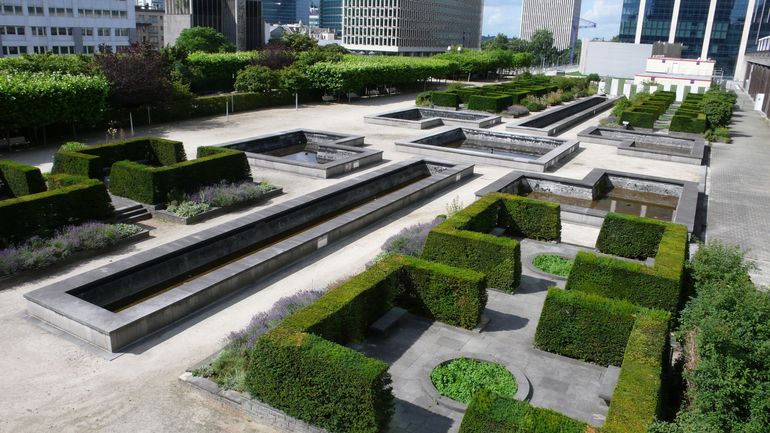
A Brussels resident who made gardening an art
René Pechère was born in Ixelles in 1908. He trained in the profession under Jules Buyssens, the great craftsman of the parks and gardens of the City of Brussels, and participated from 1935 in the creation of the gardens for the Brussels World Expo.
But it was the 1958 World Expo — Expo 58 — that revealed him to the world. In charge of the outdoor arrangements, he notably designed the Congo Gardens and the Gardens of the Four Seasons. These compositions earned him international recognition.
Throughout his career, René Pechère designed more than 900 gardens, both private and public, in Belgium as well as in France, Germany, and the Netherlands. An immense body of work, driven by a simple and then-new idea: the garden is not a decoration around a building, it is a creation in its own right.
The Mont des Arts and the Pechère brand in Brussels
Most of us have walked through a Pechère garden without knowing it. His most famous work is the gardens of the Mont des Arts, in the heart of Brussels: a space where art, history, and the city meet in a composition of great rigor.
But the list is long. He is also responsible for the gardens of the Botanical Garden of Brussels, the famous maze of the Van Buuren Museum, the gardens of the Berlaymont, those of the House of Erasmus in Anderlecht, and the park that now bears his name in Woluwe-Saint-Lambert. These are all gardens that can still be visited — a living heritage, within walking distance.
This imprint on Brussels has earned him a nickname that reflects the uniqueness of his work: "our Magritte of gardens".
His "grammar of gardens": three principles that are still relevant today.
In 1987, René Pechère published a book that became a reference: theGrammar of Gardens. The title is not a coincidence. For him, composing a garden is like writing: there is a grammar, rules, a syntax. Three principles run through all his work.
The garden is a room of the house.Pechère viewed the garden as an extension of the habitat — an "outdoor room" that continues the architecture, not a separate space. The house and the garden respond to each other.
Geometry provides the framework, the plant gives life.Straight lines, circles, squares: Pechère structured the space with clear shapes to create perspectives and guide the eye. But within this framework, he allowed the vegetation to express itself freely — textures, colours, and volumes that change with the seasons. Rigor and nature, together.
A garden is of its time.Pechère did not copy the styles of the past. He sought a language of his time, functional as well as aesthetic. A successful garden, for him, speaks of the moment it was conceived — and of those who inhabit it.
What Pechère's approach inspires us
These principles have not aged a bit — and they are not only applicable to large public gardens.
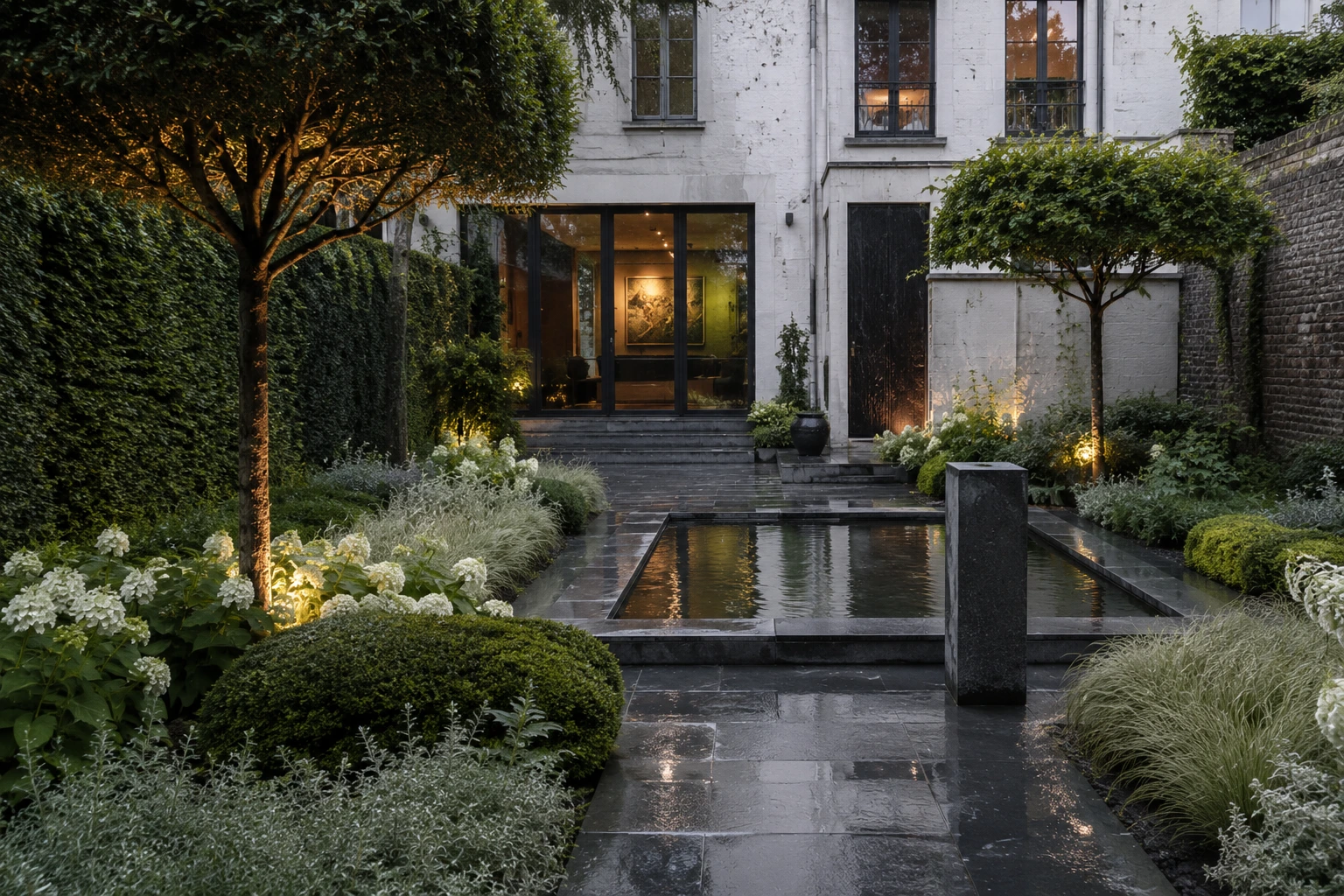
Thinking of the garden as a room in the house, structuring the space before planting, aligning the layout with the architecture and lifestyle: this is exactly the approach of a well-executed residential garden project. At Vert Val, the landscape architecture office founded by Lorenzo del Marmol in La Hulpe, this is the logic we apply to private gardens in Brabant Wallon and Brussels — starting from your home and your way of living, providing a clear structure, then letting the plants do the rest.
René Pechère does not bequeath us a style to imitate. He bequeaths us a grammar — a way of thinking before drawing. And this grammar is always the right one.
Frequently asked questions
Who was René Pechère?
René Pechère (1908-2002) is one of the greatest Belgian landscape architects of the 20th century. Born in Ixelles, trained under Jules Buyssens, he designed over 900 private and public gardens in Belgium and abroad, and is still known as "the poet of gardens."
Which gardens by René Pechère can we visit in Brussels?
Several of his creations are accessible: the gardens of Mont des Arts, those of the Botanical Garden, the maze of the Van Buuren Museum, the gardens of the House of Erasmus in Anderlecht, and the René Pechère Park in Woluwe-Saint-Lambert.
What is the "Grammar of Gardens"?
This is the reference work published by René Pechère in 1987. In it, he presents his vision of the garden as a language in its own right, with its rules of composition: the role of geometry, perspectives, and the balance between the mineral and the vegetal.
Where can I find the collection of René Pechère?
Passionate about the art of gardens, René Pechère gathered a major collection of works on the subject. Now known as the René Pechère Library, it is currently preserved in Brussels within the CIVA and serves as a reference for researchers and enthusiasts.
In summary
René Pechère demonstrated that a garden could be a thoughtful, structured, and poetic work — and that the beauty of an exterior primarily relies on a method: aligning the garden with the house, providing a clear framework, and then allowing the vegetation to thrive. It is this requirement that we put at the service of your project.