
The best schools to become a landscape architect (in Belgium, France and elsewhere)
Every month, five to six applications land in our inbox. Young graduates, people in career change, enthusiasts who have transformed their own garden and had the spark. We would love to be able to say yes to everyone — we cannot. And this simple observation already says a lot about the profession: becoming a landscape architect attracts a huge number of people, the market is vibrant, but it is demanding and competitive.
So if you are looking for a landscape architect school, here is an honest guide. Not just a list of institutions (you will find that too, verified), but what we wish someone had told us earlier: where to go, how much it costs, what makes the difference in hiring, and why this profession has, despite the competition, a bright future ahead.
A confession, to start: I did not go through a landscape school
I, Lorenzo, came to landscaping by another path. First an entrepreneur and designer — so with, already, real experience in management and projects. Then five years devouring dozens of books on great landscapers, drawing techniques, plants, underlying trends. I visited gardens, many. And above all, I tested my ideas in my own gardens, one after the other — four, to be precise. It was after the fourth that I took the plunge.
I am not telling this to show off, but because it summarises my belief: a good landscape architect is someone who has designed, but also who has executed on the ground. The plan is half the job. The other half is the clayey soil of Brabant that sticks to your boots, the drainage that we missed once and never again, the perennial that we saw die where it shouldn't have. That, no theory can replace.
The diploma is not the only path — three journeys that prove it
Before talking about schools, let’s look at three names that the whole sector respects. None have followed the “classic” route, and it is instructive.
Louis Benech (France). The landscape architect of the Tuileries, the Élysée, the grove of the Water Theatre at Versailles, and nearly 300 gardens around the world. His diploma? A master's in law. He then went to hone his skills as a horticultural worker at Hillier, in England, then a gardener in Normandy, before opening his practice in 1985. He trained “up close with the plants.”
Jacques Wirtz (Belgium). Our national pride, compared to Le Nôtre. Trained in horticulture (Vilvorde school), he started in the 1940s by going door-to-door around Schoten, doing maintenance and small jobs, while drawing in the evenings at home. He built, stone by stone, the largest landscape office in Belgium — and designed the Carrousel garden at the Tuileries. He was constantly experimenting in his own nursery. The ground, again and always.
Piet Oudolf (Netherlands). The contemporary star of the naturalistic planting, the creator of the plantings of the High Line in New York and the Lurie Garden in Chicago. Starting from nothing: he « learned everything from scratch », opened a nursery in Hummelo in 1982 and spent years cultivating, crossing, observing his plants before becoming the designer we know. A nurseryman turned master of design.
What do they have in common? They have designed and got their hands in the soil. This is exactly the philosophy of our studio.
But let's be clear, and honest: the diploma remains the officially recognised path. In Belgium, it is the ABAJP/BALA (member of IFLA) that oversees the title. Only studies in full practice are recognised; graduates of the long cycle are automatically admitted, while bachelor's degree holders must have three years of practice. For public contracts and certain doors, this diploma really matters. For the creation of private gardens, talent and experience count just as much. The two do not oppose each other — they complement each other.
The schools to become a landscape architect in Belgium
The university route (long cycle: bachelor's + master's)
It is the only university training for landscape architects in French-speaking Belgium, and it is unique in its kind: a co-diploma between three institutions — Gembloux Agro-Bio Tech (ULiège), the Haute École Charlemagne (Gembloux campus) and the Faculty of Architecture La Cambre-Horta (ULB). A transition bachelor's degree (180 credits) followed by a master's degree (120 credits). A scientific, ecological, artistic and technical approach at the same time. It is the reference if you are aiming for design offices, public space, large projects.
The higher education pathway (short cycle: professional bachelor's degree, 3 years)
More focused on practical and private project training, the course « Architecture of gardens and landscape » is notably offered at the Haute École Charlemagne (Gembloux) — which celebrated its 50th anniversary in 2019 — and at the Haute École Lucia de Brouckère (Brussels). Botany, drawing, infographics, pedology, topography, construction, internship at the end of the course. An excellent entry point into the profession of freelancer or project management assistance.
On the Dutch-speaking side (Flanders)
Two schools offer the bachelor's degree « Landscape and garden architecture » : HOGENT (Ghent, via KASK & Conservatorium) and the Erasmushogeschool Brussel. Their motto is worth noting: « you do not become a landscape architect by studying books » — from the very first day, you are in the field, and botany classes are held at the Meise Botanical Garden. Good to know: the EhB is the only one to offer a staggered schedule (Thursday evening + Friday), perfect for a career change without leaving everything behind. It is also worth noting: Flanders does not yet have an academic master's degree in this field — it is under consideration.
In France, the country of the « grandes écoles » of landscape
- ENSP Versailles — National School of Landscape Architecture, and its Marseille branch. The State Diploma in Landscape Architecture (master's level) is awarded there: it is the historic school of great French landscape architects, with a true ecological sensitivity (and, in Marseille, to the dry climate).
- School of Nature and Landscape of Blois (INSA Centre-Val de Loire), deeply rooted in the territorial project.
- Institut Agro Rennes-Angers (formerly Agrocampus Ouest), for a technical and scientific approach to plants.
Good news for Belgians: a recognised French diploma (like the DE in landscape architecture) can be validated in Belgium through an equivalence request, and Erasmus mobility allows part of the course to be completed abroad.
And internationally?
- Wageningen University (Netherlands) : the global reference in agronomy, ecology and landscape.
- Politecnico di Milano (Italy) : a very solid master's in “Sustainable Architecture and Landscape Design,” open to international perspectives.
- Harvard Graduate School of Design (United States) : the most prestigious — and the most selective (and the most expensive) MLA.
- University of Greenwich or Edinburgh School of Architecture and Landscape Architecture (United Kingdom) : very focused on design and urban planning.
What our team experiences: a multidisciplinary and international asset
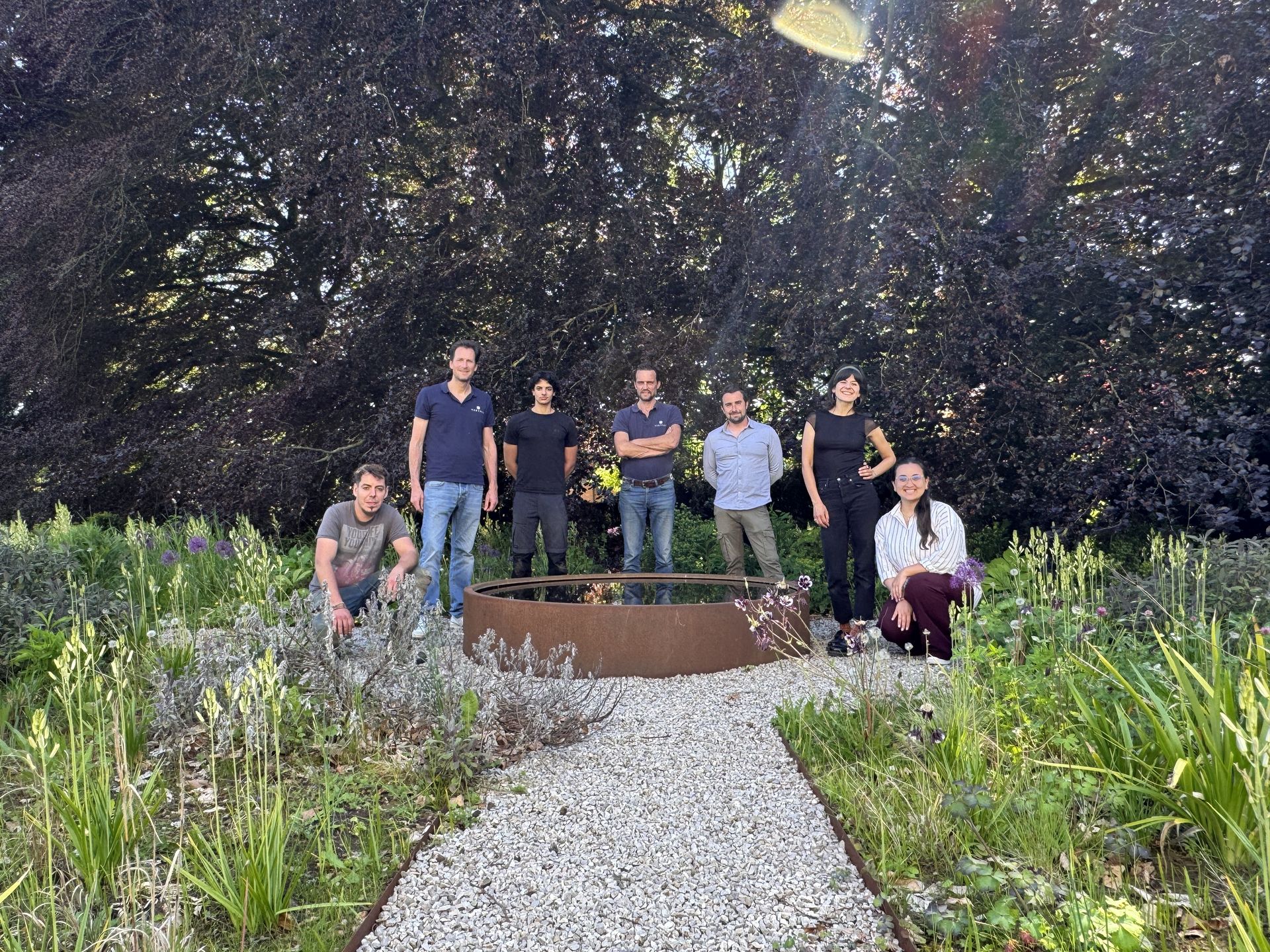
If I talk to you about all these paths, it’s because we live them every day. Our strength is not a single brain — it’s a mix.
Tala has obtained her master's in Sustainable Architecture and Landscape Design at the Politecnico di Milano, after studying architecture at the Lebanese Academy of Fine Arts in Beirut. Trilingual (English, French, Arabic), she has designed ecological parks in Italy, masters 3D modelling, QGIS, and even ENVI-met to simulate the thermal comfort of a public space. A valuable scientific rigor.
Margaux is a graduate of the ENSP Versailles-Marseille, the historic school of French landscape, complemented by the European master's EMILA (Amsterdam and Barcelona). Her approach is sensitive, almost artistic — she speaks of gardens as “messengers”, has worked on garden festivals (Chaumont-sur-Loire, Juan-les-Pins) and designs space through the senses as much as through the plan.
Add to that an interior architect who uses 3D to model our gardens before a spade hits the ground, and you get a studio that thinks about a project from all angles. It is this intersection — land, science, drawing, art, technology — that defines the quality of a garden.
How to choose your school: our very practical advice
The profession is magnificent, but the market is dense. Here are the criteria we would look at, in order.
1. Job prospects and flexibility. Be clear-sighted: many people graduate each year, and we ourselves receive five to six applications per month. What makes the difference is your uniqueness — a profile, a specialty, a real field practice.
2. Does the school adapt to new technologies? It has become decisive. The best opportunities go to technically solid landscape architects. AI, 3D, and modelling are doing amazing things today. Check that they teach assisted drawing (SketchUp, CAD), modelling, GIS — the good schools already do.
3. The site. Prefer a training with internships, project workshops, and site work. We repeat: you must know how to draw AND execute.
4. The language (French, Dutch, English) depending on the audience you want to serve.
5. The location and cost. In the Walloon-Brussels Federation, studies remain accessible: the basic tuition fee was around €835/year (free for scholarship holders, reduced for modest conditions). Note: a reform will raise it to around €1,194/year from the start of the 2026-2027 academic year. In Flanders, the tuition fee is a bit higher. In France, the DE is in a public school (modest fees). Internationally, the differences are huge (Harvard, it's several tens of thousands of euros per year). Always check the amounts for the current year on the school's website.
6. The recognition of the diploma (equivalence in Belgium, IFLA affiliation via ABAJP/BALA), especially if you are aiming for public contracts.
A profession of the future — and why climate changes the game
Sometimes we hear that the sector would be "threatened" by artificial intelligence. Our reading is more nuanced. AI is a wonderful tool — we use it. But a landscape architect who reads a soil, senses a microclimate, adjusts a plan with a spade in hand will remain irreplaceable, and this for a good while yet.
Above all, the wind is blowing in the right direction. The demand for the profession is progressing steadily, driven by the issues that are precisely ours: adaptation to climate change, management of rainwater, biodiversity, drought-resistant plants, urban densification that requires more green, not less. Warming will generate a wave of opportunities in this sector. Provided one has the right skills — technical, ecological, and practical.
To conclude
Degree from a prestigious school or an empirical path forged in one's own gardens: there is not just one right way. What matters is curiosity, practical experience, and a rule that one never lets go of — nothing is invented. A good plan is verified, a plant is known, a soil is listened to.
Are you unsure about your direction, are you changing careers, or do you dream of one day joining a team like ours? Apply here. And if you have a garden project in Walloon Brabant, Brussels or nearby, let's talk about it over a visit.
— Lorenzo del Marmol, Vert Val SRL : Studio Umilys, landscape-architect.be (La Hulpe)
FAQ
Do you need a degree to become a landscape architect in Belgium?
To hold the recognised title, join the ABAJP/IFLA and access public markets, yes: only full-time studies are recognised. To create private gardens independently, talent, practical experience and a solid network are equally important — the history of the profession proves it (Benech, Wirtz, Oudolf).
How much do landscape architect studies cost in Belgium?
In the Walloon-Brussels Federation, the tuition fee was about €835/year (free for scholarship holders), and will rise to about €1,194/year from 2026-2027. Flanders and abroad have their own rates. Always check the amount for the current year with the school.
What is the best school to become a landscape architect?
There is not just one. In French-speaking Belgium, the university route (Gembloux–ULiège / Haute École Charlemagne / ULB La Cambre-Horta) for large projects; the bachelor's degrees from higher education institutions (Charlemagne, Lucia de Brouckère) for a quick entry into the profession; in France, the ENSP Versailles-Marseille. The best depends on your goal: practical work, science or creation.